
Ask questions which are clear, concise and easy to understand.
Ask QuestionPosted by Aradhya Tripathi 6 years, 6 months ago
- 1 answers
Posted by Aradhya Tripathi 6 years, 6 months ago
- 1 answers
Yogita Ingle 6 years, 5 months ago
In India, cotton is cultivated mainly in Maharashtra, Gujarat, Haryana, Punjab, Rajasthan, Tamil Nadu and Madhya Pradesh.
Posted by Yogita Baghel 6 years, 6 months ago
- 2 answers
Sia ? 6 years, 6 months ago
The sun, planets revolving around it and all the objects bound to the sun due to gravity is called the solar system. The solar family consists of eight planets with their moons, asteroids and comets. Mercury is the planet nearest to the sun followed by Venus, Earth, Mars, Jupiter, Saturn, Uranus and Pluto.
Solar panels absorb sunlight as a source of energy to generate electricity.
Sukhwinder Kaur 6 years, 6 months ago
Posted by Yogita Baghel 6 years, 6 months ago
- 2 answers
Posted by Divyanshu Jha 6 years, 6 months ago
- 4 answers
Sia ? 6 years, 6 months ago
Vitamin D-fortified milk contains 400 IU (10 µg) of vitamin D per quart.
Posted by Raman Kumar Yadav 6 years, 7 months ago
- 5 answers
Echchha? Sharma 6 years, 6 months ago
Shruti Sinha ????? 6 years, 6 months ago
Posted by Neha Dahiya 6 years, 7 months ago
- 1 answers
Raman Kumar Yadav 6 years, 7 months ago
Posted by Muhammed P K 6 years, 7 months ago
- 4 answers
Posted by Mirza Zayaan Beg Mirza Zayaan Beg 6 years, 7 months ago
- 2 answers
Sia ? 6 years, 7 months ago
A solution that has dissolved as much solute as it is capable of dissolving at a particular temperature is said to be a saturated solution. A saturated solution cannot dissolve more of a given solute in a fixed amount of solvent at a particular temperature. E.g. When no more sugar (solute) can be dissolved in water (solvent) at a given temperature, the sugar solution is said to be saturated.
Posted by Geetha Reddy 6 years, 7 months ago
- 2 answers
Echchha? Sharma 6 years, 6 months ago
Yogita Ingle 6 years, 6 months ago
The soil is basically classified into four types:
- Sandy soil: It consists of small particles of weathered rock. Sandy soils are one of the poorest types of soil for growing plants because it has very low nutrients and poor in holding water, which makes it hard for the plant’s roots to absorb water. This type of soil is very good for the drainage system.
- Silt Soil: Silt, which is known to have much smaller particles compared to the sandy soil and is made up of rock and other mineral particles which are smaller than sand and larger than clay. It is the smooth and quite fine quality of the soil that holds water better than sand.
- Clay Soil: Clay is the smallest particles amongst the other two types of soil. The particles in this soil are tightly packed together with each other with very little or no airspace.
- Loamy Soil: It is a combination of sand, silt, and clay such that the beneficial properties from each is included. For instance, it has the ability to retain moisture and nutrients, hence, it is more suitable for farming.
Posted by Purvika Singh 6 years, 7 months ago
- 1 answers
Yogita Ingle 6 years, 6 months ago
Translational motion refers to a type of motion in which a body or object moves along a linear axis rather than a rotational axis. In physics, this term is used when referring to motion that changes the position of an object without rotation, which often plays a key part in molecular behavior. Translational motion is also referred to as linear motion.
Posted by Jaya Sarkar 6 years, 7 months ago
- 4 answers
Yogita Ingle 6 years, 7 months ago
Goat, hen, pig, lamb, fish, crabs, cow gives us meat .
Posted by Asha Poul 6 years, 7 months ago
- 3 answers
Sia ? 6 years, 7 months ago
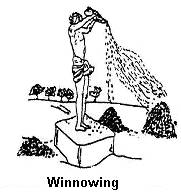
Winnowing is the process of separating wheat or rice grains from the husk. Wheat grains and husk are different in weight, husk being lighter than wheat. When the mixture is allowed to fall down from a height the wind carries the lighter husk with it and the heavy wheat grains fall vertically down on the ground.
Nandini Dutta 6 years, 7 months ago
Divyam Garg 6 years, 7 months ago
Posted by Akshat Narula 6 years, 7 months ago
- 6 answers
Shruti Sinha ????? 6 years, 6 months ago
Aaryan Rajwani 6 years, 6 months ago
Vijeta Yadav 6 years, 7 months ago
Aryan Sujeesh 6 years, 7 months ago
Posted by Azka Aman 6 years, 7 months ago
- 3 answers
Smriti Gupta 6 years, 7 months ago
Darshanadarpana Roy 6 years, 7 months ago
Posted by Rani Mandhare 6 years, 7 months ago
- 7 answers
Posted by Akshaydeep Sharma 6 years, 7 months ago
- 2 answers
Smriti Gupta 6 years, 7 months ago
Stories From All Over India 6 years, 7 months ago
Posted by Janvi Wahi 6 years, 7 months ago
- 2 answers
Posted by Chakradhar Chandrakar 6 years, 7 months ago
- 7 answers
Posted by Raghav Dutta 6 years, 7 months ago
- 1 answers
Posted by Avni Tyagi 6 years, 7 months ago
- 1 answers
Yogita Ingle 6 years, 6 months ago
Condensation: The process of conversation of water vapour into its liquid called condensation. Evaporation and condensation are used for separating a soluble solid from water. For example; salt can be separated from a solution of salt and water; by using the combination of evaporation and condensation.
Sieving: When the size of particle it too small to be picked by hand or when the quantity is too large, sieving is used for separating substances. A sieve; having holes of proper size is used. The bigger particles are retained by the sieve whereas the smaller ones pass through it. For example; this method is used for separating bran from flour, sand from gravel, pearls of different sizes, etc.
Posted by Jatin Katoch 6 years, 7 months ago
- 2 answers
Posted by Priya Tripathi 6 years, 7 months ago
- 1 answers
Yogita Ingle 6 years, 7 months ago
A bulb is made up of spherical glass which is attached to a metallic base. There is a filament inside the bulb. The filament is attached to two wires. One of the wires is attached to the metallic base of the bulb. Another wire is attached to the side of the metallic portion of the bulb.
Posted by Pandurang Bhosale 6 years, 7 months ago
- 4 answers
Yogita Ingle 6 years, 7 months ago
The major nutrients that are in our food:
- Minerals
- Water
- Vitamins
- Fat
- Protein
- Carbohydrates
Posted by Maahil Shah 6 years, 7 months ago
- 2 answers
Akshatha Mathapathi 6 years, 7 months ago
Yogita Ingle 6 years, 7 months ago
Motion is classified into various types based on the path they follow.
- Rectilinear Motion – This is a motion where objects move along a straight line. Examples march past of soldiers, sprinters in race, falling stones etc.
- Circular Motion - This is a motion where objects move along a circular path. Examples hands of a clock, blades of a fan, rotation of earth around the sun etc.A type of circular motion where an object spins on its own axis, it is called rotational motion. Example rolling ball, spinning top etc.
- Periodic Motion – This is a type of motion where the object repeats its motion after a fixed interval of time. Examples pendulum of a clock, motion of child on a swing etc.
Posted by Jai Bhagwan 6 years, 7 months ago
- 2 answers
Yogita Ingle 6 years, 7 months ago
The germinating seeds at the initial stages when a white structure has grown out of the seed are called Sprouted seeds
Take some dry seeds of moong or Chana. Put a small quantity of seeds in a container filled with water and leave this aside for a day. Next day, drain the water completely and leave the seeds in the vessel. Wrap them with a piece of wet cloth and set aside. Next day you will white structure has grown out
Posted by Shanvi Kumari 6 years, 7 months ago
- 3 answers
Dharani Gunavati 6 years, 7 months ago
Adarsh Raj 6 years, 7 months ago

myCBSEguide
Trusted by 1 Crore+ Students

Test Generator
Create papers online. It's FREE.

CUET Mock Tests
75,000+ questions to practice only on myCBSEguide app

Yogita Ingle 6 years, 5 months ago
Jute fiber is obtained from the stem of the jute plant. It is cultivated in rainy season. Jute is grown in alluvial soil which is found usually in the Delta Region of the Ganges and Brahmaputra rivers. In India, jute is mainly grown in west Bengal, Bihar and Assam. Jute plants are about 2.5 to 3.5 meter in height. It bears yellow flowers in 3 to 4 months. Jute plants are usually cut at the flowering stage. A good quality fiber is obtained from plants which are cut at the flowering stage. After falling of dry leaves bundles of dry plants are kept in a pond for a few days. In this period the gummy skin rots out to separate the fibre. This process is called retting.
The jute fiber is obtained from the retted jute by hand. Jute fibre is pale- yellow in colour and 2to 3 meter long. Jute fibre is very strong. Jute fibre has silky texture.
1Thank You