
Ask questions which are clear, concise and easy to understand.
Ask QuestionPosted by Poshan Sahu 3 years, 1 month ago
- 1 answers
Posted by Saini [*•*]☆♡ 3 years, 1 month ago
- 4 answers
Pratigya Rai 3 years, 1 month ago
Posted by Doddabasappa. N. Karamudi Doddabasappa. N. Karamudi 3 years, 1 month ago
- 4 answers
Ayush Kumar Nayak 3 years, 1 month ago
Posted by Rahul Singh 3 years ago
- 1 answers
Preeti Dabral 3 years ago
In most of the cities the responsibility of garbage disposal is on Municipal Corporations and most of the people realize no responsibility of their own. We should realize that the cleanliness is the collective responsibility of both the people and the government. If people are not aware of their responsibilities only government cannot successfully manage the garbage disposal. We must have correct idea and we must try our best to make our surroundings clean. We should not throw our wastes here and there. We should manage disposal problems at the level of our mohallas rather than waiting for government efforts.
Posted by Apurv Srivastava 3 years, 2 months ago
- 5 answers
Dhyanam Bora 3 years, 2 months ago
Avani Rathi 3 years, 2 months ago
Manjesh Kumari 3 years, 2 months ago
Posted by Patel M P 3 years ago
- 1 answers
Preeti Dabral 3 years ago
1. Keep separate containers for dry and wet waste in the kitchen.
2. Keep two bags for dry waste collection- paper and plastic, for the rest of the household waste
3. Keep plastic from the kitchen clean and dry and drop into the dry waste bin. Keep glass/plastic containers rinsed of food matter.
4. Send wet waste out of your home daily. Store and send dry waste out of the home, once a week.
5. Keep a paper bag for throwing the sanitary waste.
Posted by Gauravi Sonhivare 3 years, 2 months ago
- 3 answers
Shivam Yadav 3 years, 2 months ago
Posted by Laxman Dubey 3 years, 2 months ago
- 1 answers
Gauravi Sonhivare 3 years, 2 months ago
Posted by Ansh Verma 3 years, 2 months ago
- 5 answers
Rishabh Kumar 3 years, 1 month ago
Maneeth V 3 years, 2 months ago
Avani Rathi 3 years, 2 months ago
Posted by Khusal Thapa 3 years, 2 months ago
- 2 answers
Gauravi Sonhivare 3 years, 2 months ago
Posted by Shreyanshi Sahoo . 3 years, 2 months ago
- 5 answers
Drashti Singh 3 years, 2 months ago
Parmar Purv 3 years, 2 months ago
Posted by Khusal Thapa 3 years, 2 months ago
- 3 answers
Gauravi Sonhivare 3 years, 2 months ago
Posted by Navjot K 3 years, 2 months ago
- 5 answers
Rajeshwari Mehta 3 years, 2 months ago
Aishik Panda 3 years, 2 months ago
Posted by Raunak Kumar 3 years, 2 months ago
- 2 answers
Gauravi Sonhivare 3 years, 2 months ago
Posted by Varsha Patil 3 years, 2 months ago
- 4 answers
Vishakha Mourya 3 years ago
Maneeth V 3 years, 1 month ago
Gauravi Sonhivare 3 years, 2 months ago
Ayush Kanjilal 3 years, 2 months ago
Posted by Aaliya Asharaf 3 years, 2 months ago
- 5 answers
Posted by Priyanshu Das 3 years, 2 months ago
- 2 answers
Vanshika Malviya 3 years, 2 months ago
Posted by Priyanshu Das 3 years, 2 months ago
- 2 answers
Vanshika Malviya 3 years, 2 months ago
Posted by Anshu Ghosh 3 years, 2 months ago
- 4 answers
Rajeshwari Mehta 3 years, 2 months ago
Posted by Anshu Ghosh 3 years, 2 months ago
- 5 answers
Preeti Dabral 3 years, 2 months ago
If there is no rain for a long period or for many years, then there is scarcity of water in that region. This leads to drought. The lack of adequate precipitation, either rain or snow, can cause reduced soil moisture or groundwater , diminished stream flow, crop damage, and a general water shortage.
Avani Rathi 3 years, 2 months ago
Posted by Tapaswini Parida 3 years, 2 months ago
- 4 answers
Gauravi Sonhivare 3 years, 2 months ago
Posted by Abhaytej Singh Singh 3 years, 2 months ago
- 2 answers
Preeti Dabral 3 years, 2 months ago
It is to warn people that electricity can be dangerous if not handled properly. Carelessness in handling electricity and electric devices can cause severe injuries and sometimes even death.
Posted by Sakshi Meena 3 years, 2 months ago
- 3 answers
Posted by Virat Pahadiya 3 years, 2 months ago
- 1 answers
Kiran Patel 3 years, 2 months ago
Posted by Virat Pahadiya 3 years, 2 months ago
- 2 answers
Virat Pahadiya 3 years, 2 months ago
Posted by Kavya Singh 3 years, 2 months ago
- 1 answers
Posted by Sukhmanjeet Singh 3 years, 2 months ago
- 5 answers
Gitashree Rath 2 years, 11 months ago
Posted by Samriddhi Mishra 3 years, 2 months ago
- 2 answers
Preeti Dabral 3 years, 2 months ago
A device which converts solar energy into electrical energy.
Posted by Samriddhi Mishra 3 years, 2 months ago
- 1 answers
Abiya Grace 3 years, 2 months ago
Posted by Seena Allen 3 years, 2 months ago
- 1 answers
Preeti Dabral 3 years, 2 months ago
- Petiole: The part of the leaf by which it is attached to the stem is called petiole.
- Lamina: The broad, green part of the leaf is called lamina.
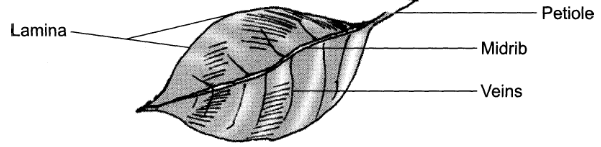
The lamina contains following parts:
- Veins: There are various types of lines on the leaf. These lines are called veins,
- Midrib: There is a thick vein in the middle of the leaf. This vein is called midrib.

myCBSEguide
Trusted by 1 Crore+ Students

Test Generator
Create papers online. It's FREE.

CUET Mock Tests
75,000+ questions to practice only on myCBSEguide app

Sharvi Bhojkar 3 years, 1 month ago
0Thank You