
Ask questions which are clear, concise and easy to understand.
Ask QuestionPosted by Faiz Ahmad 6 years ago
- 1 answers
Posted by Dhatla Komalatha Komalatha 6 years ago
- 1 answers
Rajan Kumar Pasi 5 years, 8 months ago
Using construction steps of 45degree you an make it.
and if you are allowed to use the protractor then only you can make 40 degree with it.
Posted by Ishika Aryan 6 years ago
- 1 answers
Posted by Ganesh Thakur 6 years ago
- 0 answers
Posted by Ahmad Raza 6 years ago
- 1 answers
Om Prakash 5 years ago
Posted by Anoop Verma 6 years ago
- 1 answers
Yogita Ingle 6 years ago
The 1878 Forest Act, divided forests in India into three categories reserved, protected and village forests.
The consequences of this Act were :
- Villagers used forests for different needs, i.e. for fuel, fodder and leaves. After Forest Act they could not take anything from the reserved forests.
- In forest areas people graze their cattle, collect fruits and roots and hunt animals and fish. Almost everything was available in the forest for their livelihood. The Forest Act meant severe hardship for them. All their practices became illegal.
- Circumstances forced the villagers to steal wood and if they were caught, forest guard claimed bribe from them. Women who collected fuelfood were scared of the forest guards as they harassed them and demanded free food.
- After the Forest Act, the forest department only encouraged to plant Teak and Sal tree for commercial uses.
Posted by Shaista Sultan 6 years ago
- 1 answers
Yogita Ingle 6 years ago
In binomial system of nomenclature, the generic name of a species always starts with a capital letter whereas the specific name starts with a small letter. Therefore, the correct scientific name of Mango is Mangifera indica.
Posted by Shivam Raj 6 years ago
- 1 answers
Yash Raj Singh 5 years, 6 months ago
Posted by Pradyumna Singh Shahi 6 years ago
- 1 answers
Rajan Kumar Pasi 5 years, 8 months ago
A mistake in the question, "class assado" = cast's a shadow.
Sol: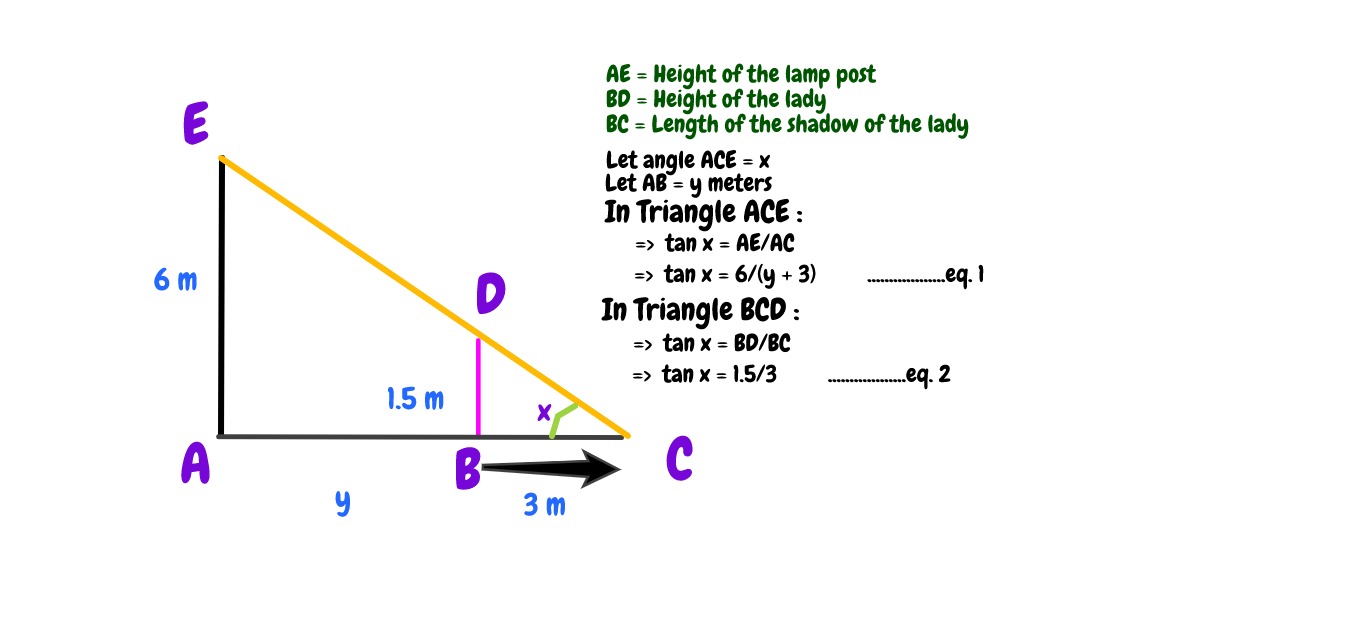
From eq. 1 and eq. 2 we will get:
{tex}\huge {=>\ \frac{6}{y+3} = \frac{1.5}{3} }\\ \huge {=>\ 6\times3 = 1.5\times(y+3) }\\ \huge {=>\ \frac{18}{1.5} = y+3}\\ \huge {=>\ 12 = \frac{y}{3} }\\ \huge {=>\ 12-3 = y }\\ \huge {=>\ y=9 }\\{/tex}
Thus, the lady is 9 meters away from the lamp post.
All the best :-)...
Posted by Priya Thakur 6 years ago
- 0 answers
Posted by Praneeth Reddy 6 years ago
- 2 answers
Posted by Dipali Nandeshwar 6 years ago
- 0 answers
Posted by Siddharth711 Gamer 6 years ago
- 0 answers
Posted by Vaishnavi Devi 6 years ago
- 1 answers
Posted by Arun Prasad 6 years ago
- 1 answers
Posted by Tilottama Mishra 6 years ago
- 0 answers
Posted by Tilottama Mishra 6 years ago
- 0 answers
Posted by Fardeen Naeem 6 years ago
- 0 answers
Posted by Lizzie Rymbzz 6 years ago
- 3 answers
Aditya Singh 3 years, 11 months ago
Manveer Kaur 5 years, 10 months ago
Vanshika Nargotra 5 years, 10 months ago
Posted by Anand Soni 6 years ago
- 0 answers
Posted by Sunita Kumari 4 years, 11 months ago
- 1 answers
Posted by Farooq Mir 6 years ago
- 1 answers
Lara Clar 5 years, 1 month ago
Posted by Lakshy Choudary 6 years ago
- 0 answers
Posted by Dèépanshu Pràsád 6 years ago
- 3 answers
Posted by Dèépanshu Pràsád 6 years ago
- 0 answers
Posted by Sainath Sainath 6 years ago
- 1 answers
Yogita Ingle 6 years ago
Positively loaded or neutral species are called electrophiles that are deficient in electrons and can accept a couple of electrons. These are also called species that love electron (philic).
- The term electrophile can be split into “electro” derived from electron and “phile” which means loving.
- They are electron deficient and hence electrons loving.
- They are positively charged or neutrally charged.
- They attract electrons. Movement of electrons depends on the density.
- They move from high-density area to low density area.
- They undergo electrophilic addition and electrophilic substitution reactions.
- An electrophile is also called as Lewis acid.
Posted by Sababanwar Ansari 4 years, 10 months ago
- 0 answers
Posted by Ashik Deewana 6 years ago
- 0 answers
Posted by P P 6 years ago
- 0 answers
Posted by P P 6 years ago
- 0 answers

myCBSEguide
Trusted by 1 Crore+ Students

Test Generator
Create papers online. It's FREE.

CUET Mock Tests
75,000+ questions to practice only on myCBSEguide app

Rajan Kumar Pasi 5 years, 8 months ago
It is a question of construction.

You should use scale, rounder (compass)and pencil to construct it.
Sol: First write all the sides or angles given (if any)
Name of quadrilateral = ABCD
Sides: AB=4cm
AC=6cm
CD=5.4cm
DA=5.4cm
First make a rough sketch to have an idea of the required sketch.
0Thank You