
Ask questions which are clear, concise and easy to understand.
Ask QuestionPosted by Riya ? 7 years, 3 months ago
- 1 answers
Posted by Tanya Sharma 7 years, 3 months ago
- 2 answers
Posted by Aman Tiwari 7 years, 3 months ago
- 1 answers
Riya ? 7 years, 3 months ago
Posted by Anjali Jais 7 years, 3 months ago
- 1 answers
Ram Kushwah 7 years, 3 months ago
download from:
https://mycbseguide.com/downloads/cbse-class-12-mathematics/1284/cbse-sample-papers/2/
Posted by Naman Mamodia 7 years, 3 months ago
- 1 answers
Posted by Honey Garg 7 years, 3 months ago
- 2 answers
Sidra Akhter 7 years, 3 months ago
Shobha??? Kumari 7 years, 3 months ago
Posted by Samarpit Samarpit 7 years, 3 months ago
- 2 answers
Abhay Shukla 7 years, 3 months ago
Shilpa Pathak 7 years, 3 months ago
Posted by Kartikey Sharma 7 years, 3 months ago
- 1 answers
Gaurav Seth 7 years, 3 months ago
An Indifference Map is a set of Indifference Curves. It depicts the complete picture of a consumer’s preferences. The following diagram showing an indifference map consisting of three curves:
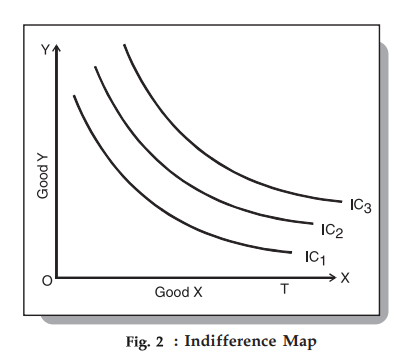
We know that a consumer is indifferent among the combinations lying on the same indifference curve. However, it is important to note that he prefers the combinations on the higher indifference curves to those on the lower ones. This is because a higher indifference curve implies a higher level of satisfaction. Therefore, all combinations on IC1 offer the same satisfaction, but all combinations on IC2 give greater satisfaction than those on IC1.
Posted by Hemant Sonar 7 years, 3 months ago
- 1 answers
Riya Jain 7 years, 3 months ago
Posted by Ishani Ikshita 4 years, 9 months ago
- 1 answers
Sia ? 4 years, 9 months ago
Posted by Aditi Shukla 7 years, 3 months ago
- 0 answers
Posted by Himanshi Gakhar 7 years, 3 months ago
- 0 answers
Posted by Shivam Jha 7 years, 3 months ago
- 1 answers
Yogita Ingle 7 years, 3 months ago
(i) Short run costs — Since in the short run (or period), some factors are fixed (like machinery, building, technical labour which cannot be changed due to insufficiency of time) and some are variable (like raw material, ordinary labour, power etc. which can be changed), therefore, the associated costs are either fixed costs or variable costs. Thus short run costs refer to the costs incurred by a firm during short period. Although main short run costs consist of Fixed Cost (FC) and Variable Cost (VC) but with their offshoots, different types of short run costs are : TVC, TFC, TC, SAC (Short run average cost), AFC, AVC and SMC (short run marginal cost). Here S stands for short run.
(ii) Long run costs — Since in the long run all the factors are variable and there is no distinction between variable factors and fixed factors, so there is no distinction between fixed costs and variable costs. All costs are variable. Therefore there is no distinction between total cost and total variable cost; between ATC and AVC. We simply use the term long run average cost denoted by LAC. Similarly we use the term LMC for marginal cost. Therefore generally two kinds of costs namely LAC (long run average costs) and LMC (long run marginal costs) are discussed. Following implications of long run costs are noteworthy.
Posted by Yashmeet Singh 7 years, 3 months ago
- 1 answers
Gaurav Seth 7 years, 3 months ago
Concepts of Ex-Ante and Ex-Post
To understand ex-ante and ex-post, let us take the example the act of going to a grocery store. You usually plan in advance, the list of items that you wish to buy from the store. When at the store, however, certain items that might not be on your list might interest you and you ‘actually’ end up purchasing more than what you had ‘planned’. What you had planned or what ‘could be’ is called ex-ante, while what actually is, is called ex-post.
Economic variables like consumption, investment, savings, etc. are all defined in terms of ex-ante and ex-post. The above example was that of planned and actual spending. There normally arises a difference or deviation between what is intended or planned and what actually takes place, and the concepts of ex-ante and ex-post account for that.
Posted by Aryan Singhania 7 years, 3 months ago
- 5 answers
Kanu Singh 7 years, 3 months ago
Posted by Gurpreet Walia 7 years, 3 months ago
- 1 answers
Zeel Patel 7 years, 3 months ago
Posted by Gurpreet Walia 7 years, 3 months ago
- 1 answers
Riya Jain 7 years, 3 months ago
Posted by Gurpreet Walia 7 years, 3 months ago
- 0 answers
Posted by Parul B 7 years, 3 months ago
- 3 answers
Kumar Abhinav 7 years, 3 months ago
Ishaa Yadav 7 years, 3 months ago
Zeel Patel 7 years, 3 months ago
Posted by Amit Agrahari 7 years, 3 months ago
- 1 answers
Zeel Patel 7 years, 3 months ago
Posted by Monika Sharma 7 years, 4 months ago
- 1 answers
Posted by Aisha Singh 7 years, 4 months ago
- 2 answers
Zeel Patel 7 years, 3 months ago
Gaurav Seth 7 years, 4 months ago
This may help you .
Table shows the summarize calculation of national income by three methods:<a href="http://cdn.economicsdiscussion.net/wp-content/uploads/2015/01/clip_image00422.jpg"> </a>
</a>
Posted by Aisha Singh 7 years, 4 months ago
- 2 answers
Zeel Patel 7 years, 3 months ago
Gaurav Seth 7 years, 4 months ago
1. Straight line method :
- This method is also known as 'original cost method'
- Under this method, depreciation is charged at fixed percentage on the original cost of the asset, throughout its estimated life.
- Under this method the amount of depreciation is uniform from year to year. That is why this method is also known as 'Fixed Installment Method' or 'Equal installment method'.
- The annual amount of depreciation can be easily calculated by the following formula :
Annual Depreciation = Original cost - Estimated scrap value
Estimated life
For example :
A firm purchases a machine for Rs 2,25,000 on April 1, 2011. The expected life of this machine is 5 years. After 5 years the scrap of this machine would be realized Rs 25,000. Under straight line method, the amount of depreciation can be calculated as under.
Hence, Rs 40,000 will be charged each year as depreciation on this machine

2. Diminishing balance method :
Under this method, depreciation is charged as a fixed percentage on the book value of the asset every year. In first year the depreciation will be charged at the end of the year, on the total cost of the asset.
For example :
| Year | Book Value (Rs) | Depreciation @ 10% (Rs) |
| 2008-09 | 20,000 | 2,000 |
| 2010-10 | 20,000--2,000=18,000 | 1,800 |
| 2010-11 | 18,000--1,800=16,200 | 1,620 |
| 2011-12 | 16,200--1,620=14,580 | 1,458 |
Hence, in this method, rate of depreciation is same but same but amount of depreciation goes on decreasing every year. Therefore, this method is also known as 'written Down Value Method' and 'Reducing Installment Method".
Posted by Harshsn Prajapat 7 years, 4 months ago
- 2 answers
Gaurav Seth 7 years, 4 months ago
Following are the main functions of money:
(i) Medium of exchange It is a very important and main function of money. Any commodity can be purchased or sold through the medium of money. In other words, money becomes the representative of general purchasing power. It is the function of money which has made the work of exchange easy because money has the merit of general acceptability.
(ii) Measure of value Money serves as a common measure of value or a standard of value. Value of all goods and services are expressed in terms of money, e.g. the price of a pen as Rs 5 the price of a book as Rs 10, etc. It is also referred to as unit of account function of money.
(iii) Store of value Wealth can be conveniently stored in the form of money because value of money remains relatively stable, compared to other commodities and storage of money does not need much space. In other words, everybody saves some part of his income to fulfil the various objectives of the future, it is known as store of value.
(iv) Standard of deferred payments Money serves as the measure by which the value of future payments is regulated. In modern economic system, loans are generally given and taken and the repayment is generally postponed for a future date. Money has made such transactions easy.
Posted by Anjali Jharia 7 years, 4 months ago
- 3 answers
Zeel Patel 7 years, 3 months ago
Posted by Umul Fathima 7 years, 4 months ago
- 4 answers
Ishaa Yadav 7 years, 3 months ago
Zeel Patel 7 years, 3 months ago
Khushi Raj 7 years, 4 months ago
Posted by Pravesh Gupta 7 years, 4 months ago
- 3 answers
Gaurav Seth 7 years, 4 months ago
NFIA is significant to differentiate between ‘Domestic Income’ and ‘National Income'
In practical estimates, domestic income is estimated first and then, National Income is derived from Domestic Income in the following manner:
National Income:
= Domestic Income
+ Factor income from abroad (due to contribution of normal residents to production outside the economic territory)
– Factor income to abroad (due to contribution of non-residents to production inside the economic territory)
The difference of Factor income from abroad and Factor income to abroad is termed as “Net factor income from abroad” or popularly abbreviated as NFIA.
So, National Income = Domestic Income + NFIA
NFIA can be Positive, Negative or Zero:
1. NFIA is Positive when income earned from abroad is more than income paid to abroad.
2. NFIA is Negative when income earned from abroad is less than income paid to abroad.
<a href="http://cdn.yourarticlelibrary.com/wp-content/uploads/2014/03/clip_image00280.jpg"> </a>
</a>
3. NFIA is Zero when income earned from abroad is equal to income paid to abroad.
Shakti Rajput 7 years, 4 months ago

myCBSEguide
Trusted by 1 Crore+ Students

Test Generator
Create papers online. It's FREE.

CUET Mock Tests
75,000+ questions to practice only on myCBSEguide app

Ishaa Yadav 7 years, 3 months ago
2Thank You