
Ask questions which are clear, concise and easy to understand.
Ask QuestionPosted by Jasmeen Kaur 6 years, 9 months ago
- 4 answers
Gursharn Kaur 6 years, 9 months ago
Yamima Rai 6 years, 9 months ago
Posted by Garima Dhingra 6 years, 9 months ago
- 2 answers
꧁≪Mämƭå ℭℏᑌĎℎàℜÿ? 6 years, 9 months ago
Posted by H V 6 years, 9 months ago
- 4 answers
Sia ? 6 years, 9 months ago
chloroplasts
The two organelles found only in plant cells are chloroplasts and central vacuoles.
Ashish Singh 6 years, 9 months ago
꧁≪Mämƭå ℭℏᑌĎℎàℜÿ? 6 years, 9 months ago
Posted by Shreya Yadav 6 years, 9 months ago
- 0 answers
Posted by Subham Sahu 6 years, 9 months ago
- 1 answers
Yogita Ingle 6 years, 9 months ago
Regeneration is one of the processes in which if an organism is cut into several pieces, each of its parts regrows to the original state. This process is carried out by specialized cells called stem cells. It takes place in organisms that have a very simple structure with very few specialized cells.
There are two types of regeneration:
Morphallaxis: This type of regeneration has little growth and depends upon tissues repatterning. For eg., Hydra grows by loss of cells from its end and by budding. When cut into two, the upper part develops into foot while the lower part develops into the head. The formation of nearby heads is inhibited by the head region.
Epimorphosis: This type of regeneration depends upon the growth of new and properly patterned structures. For eg., regeneration of a vertebrate limb. It involves cell dedifferentiation and growth. The epidermal cells form a blastema. The blastema gives rise to structures with positional distal values. Retinoic acid changes proximal-distal values in limb regeneration.
Posted by Vineet Garg 6 years, 9 months ago
- 1 answers
꧁≪Mämƭå ℭℏᑌĎℎàℜÿ? 6 years, 9 months ago
Posted by Sanu Pandey 6 years, 9 months ago
- 1 answers
꧁≪Mämƭå ℭℏᑌĎℎàℜÿ? 6 years, 9 months ago
Posted by Raja Sahu 6 years, 9 months ago
- 1 answers
꧁≪Mämƭå ℭℏᑌĎℎàℜÿ? 6 years, 9 months ago
Posted by Ashif Ali 6 years, 9 months ago
- 1 answers
꧁≪Mämƭå ℭℏᑌĎℎàℜÿ? 6 years, 9 months ago
Posted by Ďãřşháñăã Yadav ? ? ? 6 years, 9 months ago
- 1 answers
Sia ? 6 years, 9 months ago
Among the common STDs-gonorrhoea, syphilis, genital herpes, chlamydiosis, hepatitis-B, AIDs, etc., hepatitis-B, and AIDs are not infections of the reproductive organs though their mode of transmission could be through sexual contact also, AU other diseases are transmitted through sexual contact and are also infections of the reproductive tract.
Posted by Ďãřşháñăã Yadav ? ? ? 6 years, 9 months ago
- 5 answers
꧁≪Mämƭå ℭℏᑌĎℎàℜÿ? 6 years, 9 months ago
Ďãřşháñăã Yadav ? ? ? 6 years, 9 months ago
Sia ? 6 years, 9 months ago
Meiosis II, which actually forms the second polar body, occurs as a result of fertilisation. The secondary oocyte becomes a mature oocyte (ovum) by the expulsion of second polar body into perivitelline space. This results in completion of 2nd meiotic division.
Posted by Vikash Muwal 6 years, 9 months ago
- 2 answers
Kartik Singh Adhikari 6 years, 9 months ago
꧁≪Mämƭå ℭℏᑌĎℎàℜÿ? 6 years, 9 months ago
Posted by Honey Singh 6 years, 9 months ago
- 1 answers
꧁≪Mämƭå ℭℏᑌĎℎàℜÿ? 6 years, 9 months ago
Posted by Shivangi Gupta 6 years, 9 months ago
- 0 answers
Posted by Shagun Sharma 6 years, 9 months ago
- 3 answers
Posted by Sneha Chaudhary 6 years, 9 months ago
- 2 answers
Ďãřşháñăã Yadav ? ? ? 6 years, 9 months ago
꧁≪Mämƭå ℭℏᑌĎℎàℜÿ? 6 years, 9 months ago
Posted by Gyan Singh 6 years, 9 months ago
- 2 answers
Honey Singh 6 years, 9 months ago
꧁≪Mämƭå ℭℏᑌĎℎàℜÿ? 6 years, 9 months ago
Posted by Pankaj Kumar 6 years, 9 months ago
- 1 answers
Sia ? 6 years, 9 months ago
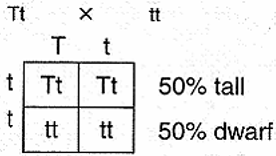
Test cross: A cross in which an individual with an unknown dominant phenotype is crossed with a recessive individual for that trait. So it is helpful in knowing the genotype (whether it is homozygous or heterozygous for the dominant trait) of an unknown individual.
Condition I: If the unknown is homozygous tall (TT) then crossing with dwarf recessive (tt) gives all tall offsprings (Tt).
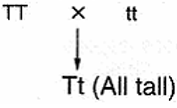
Condition II: If the unknown is heterozygous tall (Tt), then crossing with dwarf results in 50% tall (Tt) and 50% dwarf (tt) progeny.
Posted by Jasmine Jasmine 6 years, 9 months ago
- 2 answers
Sia ? 6 years, 9 months ago
Ruminate endosperm, the condition in which the endosperm is dissected by in-growths of the seed coat, is a common condition in the palms. Ruminate endosperm forms when the seed coat intrudes inward via meristematic growth. In palms, growth of the seed coat may intrude the young endosperm.
Posted by Gagandeep Kaur 6 years, 9 months ago
- 1 answers
Yogita Ingle 6 years, 9 months ago
Back cross is the cross that involves the mating of the F1 hybrid with one of its parent.
It can be explained with this example. Suppose a homozygous tall plant having genotype TT is crossed with the homozygous small plant having genotype tt, then their hybrid will be Tt (F1 plant). Now back cross is crossing this Tt individual with either TT or tt individual.
Test cross is a cross in which an individual with an unknown dominant phenotype is crossed with an individual (parent) homozygous recessive for that trait.
Posted by Samina Khan 6 years, 9 months ago
- 2 answers
꧁≪Mämƭå ℭℏᑌĎℎàℜÿ? 6 years, 9 months ago
Yogita Ingle 6 years, 9 months ago
Placenta: Placenta is a special umbilical cord that develops in the fourth week of pregnancy. It establishes an intimate connection between the foetal membrane and the uterine wall.
Posted by Swagato Karmakar 6 years, 9 months ago
- 1 answers
Sia ? 6 years, 9 months ago
If semen gets in the ******, the sperm cells can swim up through the cervix and uterus and into the fallopian tubes, looking for an egg. They have up to 6 days to find an egg before they die. When a sperm cell joins with an egg, it's called fertilization. Fertilization doesn't happen right away.
Posted by Ram Sharma 6 years, 9 months ago
- 2 answers
Pubg Pedi 6 years, 9 months ago
Posted by Ankshuman Gohain 6 years, 9 months ago
- 1 answers
Mekya Tajo 6 years, 9 months ago
Posted by Deepanshu Rajput 6 years, 9 months ago
- 0 answers
Posted by Shamsh Tabrez Khan 6 years, 9 months ago
- 2 answers
Souromi Chatterjee 6 years, 9 months ago
Souromi Chatterjee 6 years, 9 months ago
Posted by Manjeet Yadav 6 years, 9 months ago
- 1 answers
Yogita Ingle 6 years, 9 months ago
Chromosomes are thread-like structures woven together . They are located inside the nucleus of animal and plant cells. Each chromosome happens to be made of proteins and a single molecule of deoxyribonucleic acid or commonly abbreviated to DNA.
Chromosomes basically control all the activities of a living cell. DNA present on the chromosome not only carries most of the genetic information but also controls the hereditary transference.
Chromosomes are essential for the process of cell division, are responsible for replication, division, and creation of daughter cells which contain correct sequences of DNA and proteins.
Chromosomes are often called as the 'packaging material', because it tightly holds the DNA and proteins together in the eukaryotic cells.
Posted by Ďãřşháñăã Yadav ? ? ? 6 years, 9 months ago
- 1 answers
Yogita Ingle 6 years, 9 months ago
Alfred Sturtevant was a student of Morgan who mapped the positions of genes on a chromosome by using the frequency of recombination between the gene pairs present on the same chromosome. He used the data obtained as a measure of distance between two genes. This process of mapping the gene positions was termed as 'gene mapping'.
Posted by Ude Gill 6 years, 9 months ago
- 1 answers
Meghna Thapar 5 years, 8 months ago
Wind-pollinated flowers are typically:
- No bright colors, special odors, or nectar.
- Small.
- Most have no petals.
- Stamens and stigmas exposed to air currents.
- A large amount of pollen.
- Pollen smooth, light, easily airborne.
- Stigma feathery to catch pollen from wind.
Posted by Abhay Singh 6 years, 9 months ago
- 3 answers

myCBSEguide
Trusted by 1 Crore+ Students

Test Generator
Create papers online. It's FREE.

CUET Mock Tests
75,000+ questions to practice only on myCBSEguide app

Somya Sharma 6 years, 9 months ago
3Thank You