
Ask questions which are clear, concise and easy to understand.
Ask QuestionPosted by Vijay Pandey 6 years, 5 months ago
- 0 answers
Posted by Dimple Chandel 4 years, 8 months ago
- 1 answers
Sia ? 4 years, 8 months ago
Posted by Marak Hungyo 6 years, 5 months ago
- 0 answers
Posted by Zeex Infinity 6 years, 5 months ago
- 0 answers
Posted by Zeex Infinity 6 years, 5 months ago
- 0 answers
Posted by Kartik Kumar 6 years, 5 months ago
- 1 answers
Anuradha Nitin 6 years, 5 months ago
Posted by Nanci Bhati 6 years, 5 months ago
- 3 answers
Yogita Ingle 6 years, 5 months ago
| Basis for Differentiation | Microeconomics | Macroeconomics |
|
Meaning |
Microeconomics studies the particular market segment of the economy | Macroeconomics studies the whole economy, that covers several market segments |
| Deals with? | Microeconomics deals with various issues like demand, supply, factor pricing, product pricing, economic welfare, production, consumption, etc., | Macroeconomics deals with various issues like national income, distribution, employment, general price level, money, etc., |
| Business Application | Applied to internal issues | Environment and external issues |
| Scope | Covers several issues like demand, supply, factor pricing, product pricing, economic welfare, production, consumption, etc. | Covers several issues like distribution, national income, employment, money, general price level, etc., |
| Significance | Useful in regulating the prices of a product alongside the prices of factors of production (labour, land, entrepreneur, capital, etc) within the economy | Perpetuates firmness in the broad price level and solves the major issues of the economy like deflation, inflation, rising prices (reflation), unemployment and poverty as a whole |
| Limitations | It is based on impractical presuppositions, i.e. In microeconomics, it is presumed that there is full employment in the community which is not at all feasible | It has been scrutinized that Misconception of Composition’ incorporates, which sometimes fails to prove accurate because it is feasible that what is true for aggregate (comprehensive) may not be true for individuals too |
Posted by Priti Singh 6 years, 5 months ago
- 0 answers
Posted by Komal Bhardwaaj 6 years, 5 months ago
- 1 answers
Posted by Parul Mittal 6 years, 5 months ago
- 2 answers
Posted by Muskan Jindal 6 years, 5 months ago
- 0 answers
Posted by Aman Negi 6 years, 5 months ago
- 1 answers
Hir Thakker 6 years, 5 months ago
Posted by Aman Negi 6 years, 5 months ago
- 2 answers
Anuradha Nitin 6 years, 5 months ago
Hir Thakker 6 years, 5 months ago
Posted by Akash Jain 6 years, 5 months ago
- 2 answers
Hir Thakker 6 years, 5 months ago
Posted by Saniya Khan 6 years, 5 months ago
- 1 answers
Saniya Khan 6 years, 5 months ago
Posted by Sawan Esha Bhatnagar 6 years, 5 months ago
- 1 answers
Hir Thakker 6 years, 5 months ago
Posted by Muskan Jindal 4 years, 8 months ago
- 1 answers

Posted by Akash Baxla 6 years, 5 months ago
- 0 answers
Posted by Kunika Sharma 6 years, 5 months ago
- 1 answers
Yogita Ingle 6 years, 5 months ago
The law of demand is one of the most fundamental concepts in economics. It works with the law of supply to explain how market economies allocate resources and determine the prices of goods and services that we observe in everyday transactions. The law of demand states that quantity purchased varies inversely with price. In other words, the higher the price, the lower the quantity demanded. This occurs because of diminishing marginal utility. That is, consumers use the first units of an economic good they purchase to serve their most urgent needs first, and use each additional unit of the good to serve successively lower valued ends.
Posted by Jaswinder Sohi 6 years, 5 months ago
- 0 answers
Posted by Abhi Mollik 6 years, 5 months ago
- 0 answers
Posted by Wangchu Gengla 6 years, 5 months ago
- 2 answers
Posted by Harshit Shisodiya 6 years, 5 months ago
- 0 answers
Posted by Manish Sharma 6 years, 6 months ago
- 0 answers
Posted by Kazi Aftab 6 years, 6 months ago
- 2 answers
Saniya Khan 6 years, 5 months ago
Saniya Khan 6 years, 5 months ago
Posted by Nitin Rajput Rajput 6 years, 6 months ago
- 0 answers
Posted by Saniya Khan 6 years, 6 months ago
- 2 answers
Saniya Khan 6 years, 6 months ago
Posted by Roshan Singh 6 years, 6 months ago
- 1 answers
Gaurav Seth 6 years, 6 months ago
- Meaning: Quantity Demanded represents exact quantity (how much) of a good or service is demanded by consumers at a particular price.
- What is it? : It is the actual amount of goods desired at a certain price.
- Change: Expansion or contraction in demand.
- Reasons: Price
- Measurement of change: Movement along demand curve
- Consequences of change in actual price: Change in quantity demanded.
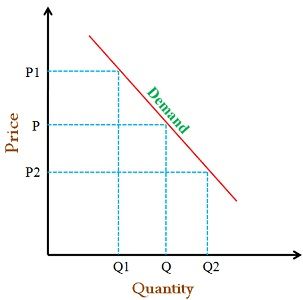
Quantity Demanded refers to how much of an economic good or service is demanded by a consumer or a group of consumers at a given period at a certain price. There are two important points related to quantity demanded which are,
- It is always expressed at a given price, in essence, different quantities are demanded at different prices.
- It is a flow which means quantity demanded doesn’t indicate a single purchase rather a continuous flow of purchases.
The given below figure represents the movement along demand curve due to changes in price, i.e. the upward movement of demand curve indicates the contraction of demand whereas a downward shift denotes the expansion of demand.

myCBSEguide
Trusted by 1 Crore+ Students

Test Generator
Create papers online. It's FREE.

CUET Mock Tests
75,000+ questions to practice only on myCBSEguide app
