
Ask questions which are clear, concise and easy to understand.
Ask QuestionPosted by Raj Mahur 5 years, 2 months ago
- 0 answers
Posted by Pika Pika 5 years, 2 months ago
- 0 answers
Posted by Satyam Jha 5 years, 2 months ago
- 0 answers
Posted by Zarka Hussain 5 years, 2 months ago
- 1 answers
Yogita Ingle 5 years, 2 months ago
Yes,economics in a very basic sense is optimization given the constraints. Scarcity is the biggest and real constraint of our lives.Lets understand with an example,suppose everybody has a lot of money,a lot to buy anything.What would the world look like?Nobody's going to work,no production,no costs,no profits,no exchange rates,no trade,simply there would be no need of any of the economic agents,economic concepts.So,no economics would exist.
Posted by Khushboo Taravar 5 years, 2 months ago
- 1 answers
Posted by Mohit Bhati 5 years, 2 months ago
- 2 answers
Binay Budhia 5 years, 2 months ago
Muskan ?? 5 years, 2 months ago
Posted by Darshana Agarwal 5 years, 2 months ago
- 2 answers
Account Deleted 5 years, 2 months ago
Gaurav Seth 5 years, 2 months ago
It is true that the scarcity is the root of all economic problems. If there had been no scarcity there would have been no economic problem. This would have not necessitated the study of economics.
In our daily life, we face various forms of scarcity. The queues at the railway booking counters, over crowded buses, heavy traffic on roads, the rush to get a ticket to watch a movie of a popular film actor or actress, are all the manifestations of scarcity. We face scarcity because the things that satisfy our wants are limited in availability.
Further, the resources which the producers have are limited and also have alternative uses. For instance, take the case of food that we eat everyday. It satisfies our want of nourishment.
Farmers employed in agriculture grow crops that produce our food. At any point of time, the resources in agriculture like land, labour, water, chemical fertilizers, etc, all these resources have alternative uses.
The same resources can be used in the production of non-food crops. Thus, alternative uses of resources give rise to the problem of choice between different commodities that can be produced by those resources.
Posted by Guna .M 5 years, 2 months ago
- 0 answers
Posted by Akssa Begum 5 years, 2 months ago
- 3 answers
Yogita Ingle 5 years, 2 months ago
Keeping all other factors the same, when there is a change in demand of a commodity due to change in price, it is referred to as the change in quantity demanded. It is shown as a movement along the demand curve when expressed graphically.
Posted by Akssa Begum 5 years, 2 months ago
- 3 answers
Kripa Agrawal 5 years, 2 months ago
Yogita Ingle 5 years, 2 months ago
Changes in demand include an increase or decrease in demand. Due to the change in the price of related goods, the income of consumers, and the preferences of consumers, etc. the demand for a product or service changes.
So there are two possible changes in demand:
- Increase (shift to the right) in demand
- Decrease (shift to the left) in demand
Posted by Akssa Begum 5 years, 2 months ago
- 1 answers
Yogita Ingle 5 years, 2 months ago
Law of demand is regarded as one of the most basic concepts that is being studied in the field of Economics. It states that keeping all other factors constant (cetris peribus) the demanded quantity of a good is shown to exhibit an inverse relationship with the price of a good.
In simple words, with an increase in price, the demand decreases and with a decrease in price, the demand increases. The law of demand is used in conjunction with the law of supply to determine efficient resource allocation and optimum quantity and price of goods.
The consumer preference theory helps in understanding the combination of goods that a consumer might prefer taking into account budgetary constraints and price of goods in the market.
The best explanation for this is found in Microeconomics using the demand function, where demand functions are derived from the indifference curves.
Posted by Akssa Begum 5 years, 2 months ago
- 2 answers
Gaurav Seth 5 years, 2 months ago
(i) Price of the commodity: When price of the commodity increases in the market, its quantity decreases and vice-versa.
(ii) Income of the consumer: Market demand for a commodity is directly related to income of the consumer. Increase in income of consumer causes increase in market demand for the commodity.
(iii) Prices of related goods: In case of substitute goods, demand for a commodity falls with fall in price of the substitute commodity. In case of complementary goods, market demand for the commodity rises with a fall in the price of complementary commodity.
(iv) Tastes and Preferences: If consumer's tastes and preferences change, quantity demanded of the commodity will also change.
(v) Income Distribution: If income distribution is even, market demand for the commodity will be more than otherwise.
(vi) Size of Population: Higher population implies greater market demand for goods and services and vice-versa.
Posted by Akssa Begum 5 years, 2 months ago
- 1 answers
Gaurav Seth 5 years, 2 months ago
The Price Elasticity of Demand refers to the degree of responsiveness of demand to the change in the price of the commodity.
Types of price Elasticity of Demand:
The following are the main types of price elasticity of demand:
1. Relatively Elastic Demand:
Relatively elastic demand refers to the demand when the proportionate change produced in demand is greater than the proportionate change in price of a product. The numerical value of relatively elastic demand ranges between one to infinity.
2. Relatively Inelastic Demand:
Relatively inelastic demand is one when the percentage change produced in demand is less than the percentage change in the price of a product. The numerical value of relatively elastic demand ranges between zero to one (ep<1).
3. Unitary Elastic Demand:
When the proportionate change in demand produces the same change in the price of the product, the demand is referred as unitary elastic demand. The numerical value for unitary elastic demand is equal to one (ep=1).
4. Perfectly Elastic Demand:
When a small change in price of a product causes a major change in its demand, it is said to be perfectly elastic demand. In perfectly elastic demand, a small rise in price results in fall in demand to zero, while a small fall in price causes increase in demand to infinity. In such a case, the demand is perfectly elastic or ep = 00.
5. Perfectly Inelastic Demand:
A perfectly inelastic demand is one when there is no change produced in the demand of a product with change in its price. The numerical value for perfectly inelastic demand is zero (ep=0).
Posted by Khushboo Taravar 5 years, 2 months ago
- 0 answers
Posted by Khushboo Taravar 5 years, 2 months ago
- 1 answers
Yogita Ingle 5 years, 2 months ago
Indifference Set : It is a set of those combination of two goods which offer the consumer the same level of satisfaction, so that, the consumer is indifferent across any number of combination in his indifference set.
Monotonic Preferences : onotonic preferences refers to a situation where the consumer will prefer more quantity of commodities than lesser quantity.
Posted by Priya Yadav 5 years, 2 months ago
- 1 answers
Yogita Ingle 5 years, 1 month ago
Whereas the contraction in demand implies the fall in quantity demanded as a result of rise in price, decrease in demand means the whole demand curve shifts to a lower position. In other words, decrease in demand means that at various prices, less is demanded than before. The decrease in demand does not occur due to the rise in price but due to the changes in other determinants of demand.
Posted by Taslima Iqbal 5 years, 2 months ago
- 1 answers
Gaurav Seth 5 years, 2 months ago
Merits of Arithmetic Mean :
(i) To present a brief picture of data : The main purpose of average is to present a simple and systematic description of the data.
(ii) To represent the universe : It also helps to obtain a picture of a complete group.
(iii) Basis of statistical analysis : It is the basis of statistical analysis and analyze the data.
(iv) To facilitate comparison : It helps in comparing the data of various categories.
Demerits of Arithmetic Mean :
(i) The arithmetic mean is highly affected by extreme values.
(ii) It cannot average the ratios and percentages properly.
(iii) It is not an appropriate average for highly skewed distributions.
(iv) It cannot be computed accurately if any item is missing.
Posted by Priya Yadav 5 years, 2 months ago
- 1 answers
Gaurav Seth 5 years, 2 months ago
if the other things, that is, determinants of demand other than price such as consumers’ tastes and preferences, income, price of the related goods change, the whole demand curve will change. When due to the changes in these other factors, the demand curve shifts upwards, increase in demand is said to have occurred.
Increase in demand means the consumer buys more of the good at various prices than before. For example, if the income of a consumer increases, or if the fashion for a goods increases, the consumer will buy greater quantities of the goods than before at various given prices. As a result the whole demand curve will shift upward.
In brief increase in demand occurs due to the following reasons:-
(i) The fashion for a goods increases or people’s tastes and preferences become more favourable for the good;
(ii) Consumer’s income increases.
(iii) Prices of the substitutes of the goods in question have risen.
(iv) Prices of complementary goods have fallen.
Posted by .... .... 5 years, 2 months ago
- 1 answers
Gaurav Seth 5 years, 2 months ago
SOLUTION
Shifts to the right.
Demand for inferior goods has an opposite relationship with consumer's income. If there is a decline in the income of the consumer, the demand for an inferior good rise. Therefore, the consumer demand curve shifts towards the right
Posted by .... .... 5 years, 2 months ago
- 0 answers
Posted by .... .... 5 years, 2 months ago
- 2 answers
Gaurav Seth 5 years, 2 months ago
In the initial stages of production, a firm may be enjoying increasing returns to a factor (because of underutilisation of the fixed factor). It is a situation when MP (of the variable factor) tends to rise. Cost is just the opposite of productivity. Rising MP means falling cost. When the cost of producing an additional unit is falling, TVC should be increasing only at the decreasing rate.
Yogita Ingle 5 years, 2 months ago
In the initial stages of production, a firm may be enjoying increasing returns to a factor (because of underutilisation of the fixed factor). It is a situation when MP (of the variable factor) tends to rise. Cost is just the opposite of productivity. Rising MP means falling cost. When the cost of producing an additional unit is falling, TVC should be increasing only at the decreasing rate.
Posted by .... .... 5 years, 2 months ago
- 1 answers
Yogita Ingle 5 years, 2 months ago
a) When AR is decreasing, MR should be decreasing faster than AR. Thus, downward sloping MR curve is below the downward sloping AR curve(a situation of monopoly and monopolistic competition)
b) If AR is constant, MR is equal to AR. Both are indicated by the same horizontal straight line(a situation of perfect competition)
Posted by @_ Dreamer 5 years, 2 months ago
- 2 answers
Gaurav Seth 5 years, 2 months ago
How to produce?
This aspect deals with the process or technique by which the goods and services can be produced. Generally, there are two techniques that can be used for producing, which are:
- Labour Intensive Techniques
- Capital Intensive Techniques
The choice of technique for production depends on the availability of the resource in that nation, and hence resource allocation becomes a challenge.
Yogita Ingle 5 years, 2 months ago
An economic problem generally means the problem of making choices which occurs because of the scarcity of resources. The economic problem arises because people have unlimited desires but the means to satisfy that desire is limited. Therefore, satisfying all human needs are difficult with limited means.
Causes of Economic Problem
- Scarcity of Resources- Resources like labor, land, and capital, etc. are insufficient as compared to the demand. Therefore, the economy cannot provide everything that people want.
- Unlimited Human Wants- Human beings demands and wants are unlimited and never ends, which means they will never be satisfied. If a person one wants is satisfied, they will start tempting some new desires. People wants are unlimited and keep multiplying, therefore, cannot be satisfied because of limited resources.
- Alternative Uses- Resources being scarce they are put into different uses. So, to make a choice among resources are essential. For instance, petrol is not only used in a vehicle but it is also used for generator, running machine, etc. So, now the economy should make a choice within the alternative uses.
Posted by @_ Dreamer 5 years, 2 months ago
- 1 answers
Gaurav Seth 5 years, 2 months ago
| Output | Fixed Cost | Variable Cost | Total Cost |
| 0 | 40 | 0 | 40 |
| 1 | 40 | 20 | 60 |
| 2 | 40 | 30 | 70 |
| 3 | 40 | 32 | 72 |
| 4 | 40 | 34 | 74 |
| 5 | 40 | 36 | 76 |
| 6 | 40 | 38 | 78 |
| 7 | 40 | 40 | 80 |
| 8 | 40 | 46 | 86 |
- We see that the Fixed Cost remains the same even as production increases from 0 to 8 units. Thus the value of FC = 40
- It can be noted that the Variable Cost increases as the output increases. The VC increases at a diminishing rate till 7 units of output, after which it starts increasing at an increasing rate.
- The final column shows the Total Cost which is the sum of FC and VC and increases as the output increases.
Posted by .... .... 5 years, 2 months ago
- 2 answers
Gaurav Seth 5 years, 2 months ago
The costs which involve outflow of cash due to the use of factors of production is known as Explicit Cost. Depreciation is a Deemed Explicit Cost, as the cost of the asset is apportioned during the useful life of the asset.
Posted by Paridhi Chug 5 years, 2 months ago
- 2 answers
Gaurav Seth 5 years, 2 months ago
Owing to their poverty (and immediate need for cash) farmers are often driven to a distressed sale of their produce. But good harvest causes a glut (of supply) in the market. This causes a price-crash. The price may fall so much that the total revenue of the farmer decreases even when his output/sale is more than before.
Yogita Ingle 5 years, 2 months ago
Owing to their poverty (and immediate need for cash) farmers are often driven to a distressed sale of their produce. But good harvest causes a glut (of supply) in the market. This causes a price-crash. The price may fall so much that the total revenue of the farmer decreases even when his output/sale is more than before.
Posted by Paridhi Chug 5 years, 2 months ago
- 1 answers
Yogita Ingle 5 years, 2 months ago
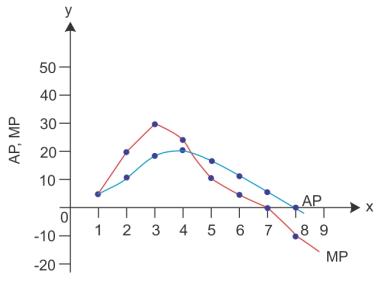
Here the table and the diagram below shows the following relationship between AP and MP:
• AP increases as long as MP is greater than AP. Till the point p, AP is at maximum.
• AP decreases when MP < AP. Beyond the point p, AP is at its top.
• AP is at its maximum when AP = MP. MP curve cuts AP from above at its maximum.
• MP may be zero or negative, but AP remains positive.
|
Units of Fixed Factor |
Units of Variable Factor |
AP |
MP |
|
1 |
0 |
0 |
0 |
|
1 |
1 |
4 |
4 |
|
1 |
2 |
10 |
16 |
|
1 |
3 |
16 |
28 |
|
1 |
4 |
17 |
20 |
|
1 |
5 |
16 |
10 |
|
1 |
6 |
14 |
4 |
|
1 |
7 |
12 |
0 |
|
1 |
8 |
1 |
-4 |

myCBSEguide
Trusted by 1 Crore+ Students

Test Generator
Create papers online. It's FREE.

CUET Mock Tests
75,000+ questions to practice only on myCBSEguide app
