
Ask questions which are clear, concise and easy to understand.
Ask QuestionPosted by Monika Gaur 4 years, 3 months ago
- 2 answers
Kavya Chanana 4 years, 3 months ago
Posted by Phibaiakmenlang Phibaiakmenlang 4 years, 3 months ago
- 2 answers
Kavya Chanana 4 years, 3 months ago
Raj Narayan Tiwari 4 years, 3 months ago
Posted by Dear Friend 4 years, 3 months ago
- 1 answers
Posted by Anay Singh 4 years, 3 months ago
- 0 answers
Posted by Lalchhanchhuahi Chhuahi 4 years, 3 months ago
- 1 answers
Kavya Chanana 4 years, 3 months ago
Posted by Piyush Mohi 4 years, 3 months ago
- 1 answers
Posted by Shruti Pandit 4 years, 3 months ago
- 1 answers
Kavya Chanana 4 years, 3 months ago
Posted by Aman Kaur 4 years, 3 months ago
- 3 answers
Arushi Sareen 4 years, 3 months ago
Posted by Yash Jain 4 years, 3 months ago
- 0 answers
Posted by Shantanu Patra Roll :- 6 Commerce_. 4 years, 3 months ago
- 2 answers
Posted by Dhwani Bhatia 9 months ago
- 0 answers
Posted by Ankita Patel 4 years, 4 months ago
- 0 answers
Posted by Syed Furkhan 4 years, 4 months ago
- 0 answers
Posted by Swara Gaikwad 4 years, 4 months ago
- 2 answers
Sia ? 4 years, 4 months ago
Measurement of Unemployment:
- Usual Status (UPS):
The Usual Status approach to measuring unemployment uses a reference period of 365 days i.e. one year preceding the date of the survey of NSSO for measuring unemployment.
The Usual Status approach of measuring unemployment also looks at the principal activity and subsidiary activity status of the worker. - Current Weekly Status:
The Current Weekly Status (CWS) approach to measuring unemployment uses seven days preceding the date of survey as the reference period.
A person is considered to be employed if he or she pursues any one or more of the gainful activities for at least one-hour on any day of the reference week. On the other hand, if a person does not pursue any gainful activity, but has been seeking or available for work, the person is considered as unemployed. - Current Daily Status (CDS): The current daily status approach to measuring unemployment seeks to ascertain the activity status of an individual for each day of the reference week. It reports time disposition of an individual on each day of the reference week. This means that in addition to recording the activity being pursued, time intensity is also recorded in quantitative terms for each day of the reference week.
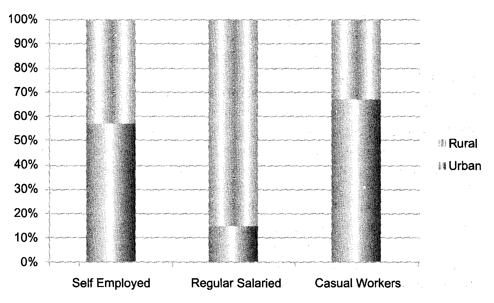
Unemployment Rates (2004 per 1000)
Rural Males Rural Females Urban MAles Urban Females UPS 24 22 46 89 CWS 47 45 57 10 CDS 90 93 81 117
Posted by Muskan Grover 4 years, 4 months ago
- 1 answers
Posted by Rohit 11Th C 4 years, 4 months ago
- 1 answers
Posted by Pratham Shrivastava 4 years, 4 months ago
- 0 answers
Posted by Priya Minj 4 years, 4 months ago
- 1 answers
Purva Sharma 4 years, 4 months ago
Posted by Priyanshu Kashyap 4 years, 4 months ago
- 1 answers
Sia ? 4 years, 4 months ago
- Set your goals.
- Narrow down on your target population.
- Structure the survey.
- Select the mode of your survey.
- Choose the right question type.
- Formulate the questions.
- Introduce the survey.
- Take the field.
Posted by Manju Panwar 4 years, 4 months ago
- 0 answers
Posted by Mahi Sharma 4 years, 4 months ago
- 1 answers
Posted by Piyush Keshari 4 years, 4 months ago
- 1 answers
Sia ? 4 years, 4 months ago
Individual demand function refers to the functional relationship between demand made by an individual consumer and the factors affecting the individual demand. It shows how demand made by an individual in the market is related to its determinants.
Posted by Suraj Kumar 4 years, 4 months ago
- 0 answers
Posted by Chirag Yadav 4 years, 4 months ago
- 2 answers
Harshit Sharma 4 years, 4 months ago
Posted by Narayan Dahal 4 years, 4 months ago
- 1 answers
Sia ? 4 years, 4 months ago
Presentation of data refers to an exhibition or putting up data in an attractive and useful manner such that it can be easily interpreted. The three main forms of presentation of data are: Textual presentation. Data tables. Diagrammatic presentation.

myCBSEguide
Trusted by 1 Crore+ Students

Test Generator
Create papers online. It's FREE.

CUET Mock Tests
75,000+ questions to practice only on myCBSEguide app

Palak Bansal 4 years, 3 months ago
0Thank You