
Ask questions which are clear, concise and easy to understand.
Ask QuestionPosted by Vikrant Narwal 6 years, 8 months ago
- 1 answers
Posted by Vivek Tiwari 6 years, 8 months ago
- 2 answers
Abhay Anjaan 6 years, 8 months ago
Yogita Ingle 6 years, 8 months ago
“The phenomenon of ejection of electrons from the surface of a metal when light of suitable frequency strikes on it, is called photoelectric effect.
The emitted electrons are called photoelectrons.”
Experimental studies of photoelectric effect under different conditions led to the following important observations—
(i) The electrons are ejected from the metal surface as soon as the beam of light strikes the surface. .
(ii) For each metal, certain minimum frequency of light is needed to eject the electrons. This is known as threshold frequency and it is different for different metals.
(iii) The kinetic energy of the ejected electrons is directly proportional to the frequency of the incident radiation and it is independent of its intensity.
(iv) The number of electrons ejected per second from the metal surface depends upon the intensity or brightness of incident radiation but does not depend upon its frequency
Posted by Adarsh Kesharwani 6 years, 8 months ago
- 1 answers
Yogita Ingle 6 years, 8 months ago
There are 18 groups in periodic table & each group is a independent group. All the elements present in a group have same electronic configuration of the atoms. The physical and chemical properties of elements depend on the number of valence electrons. Elements present in the same group have the same number of valence electrons. Therefore, elements present in the same group have similar physical and chemical properties
Posted by Priyanshu Bharadwaj 6 years, 8 months ago
- 1 answers
Posted by Shashi Ranjan 6 years, 8 months ago
- 2 answers
Posted by Kuki Reddi 6 years, 8 months ago
- 1 answers
Jatin Garg???? 6 years, 7 months ago
Posted by Shraddha Singh 6 years, 8 months ago
- 1 answers
Jatin Garg???? 6 years, 7 months ago
Posted by Ayush Vishwakarma?? 6 years, 8 months ago
- 2 answers
Khushi Tanwar 6 years, 8 months ago
Yogita Ingle 6 years, 8 months ago
Limitations of Mendeléev’s classification
- No fixed position could be assigned to hydrogen in the Periodic Table.
- Isotopes discovered long after Mendeléev periodic classification of
elements imparted a challenge to Mendeleev’s Periodic Law. - The atomic masses of elements did not increase in a steady manner while going from one element to other which made it difficult to predict the number of elements that could be discovered between two elements.
Posted by Varun Varuna 6 years, 8 months ago
- 2 answers
Yogita Ingle 6 years, 8 months ago
Factors on which electron gain enthalpy depends:
Atomic size. As the size of an atom increases, the distance between its nucleus and the incoming electron also increases. Therefore, the force of attraction between the nucleus and the incoming electron decreases and hence the electron gain enthalpy becomes less negative.
Nuclear charge. As the nuclear charge increases force of attraction for the incoming electron increases and thus electron gain enthalpy becomes more negative.
Symmetry of electronic configuration. Elements having symmetrical configuration (Either half filled or fully filled orbitals in the same sub shell) having no attraction for electron because by accepting electron their configuration becomes less stable. In that case energy has to be supplied to accept electron. Thus electron gain enthalpy will be positive.
Posted by Vignesh Babu 6 years, 8 months ago
- 2 answers
Yogita Ingle 6 years, 8 months ago
Molality is also known as Molal Concentration and It is one measue for Solute concentration
Molality is defined as the number of moles of solute dissolved per 1000 g (1 kg) of solvent. Molality is expressed as 'm'unit = Moles kg-1
m = no of moles of solute /weight of solvent(kg)
Jatin Garg???? 6 years, 8 months ago
Posted by Shangba Elex 6 years, 8 months ago
- 0 answers
Posted by Suhana Singh 6 years, 8 months ago
- 4 answers
Yogita Ingle 6 years, 8 months ago
|
MOLAR MASS |
MOLECULAR MASS |
|
Refers to mass of a mole of a substance |
Refers to the mass of molecules |
|
Also known as molecular weight |
It determines the mass of single molecule |
|
SI unit is g/mol to use in higher calculations |
Measured in amu |
|
It is defined as the mass of Avogadro number of atoms/molecules or compounds |
No particular melting point |
|
Measurement given to compounds, atoms or molecules |
Determined only in molecules |
|
Less accurate than molecular mass |
Accurate to use in higher calculations |
|
Example: Mass of 1 mole of oxygen is 15.9994 grams. Therefore the molar mass = 15.9994 g/mol |
Example: Molecular mass of Ca(OH)2 = 74 atomic mass units |
Manish Kumar 6 years, 8 months ago
Posted by Nixa Singh 6 years, 8 months ago
- 1 answers
Amisha Meena 6 years, 7 months ago
Posted by Aryan Chogale 6 years, 8 months ago
- 1 answers
Gulshan Pratap Singh 6 years, 8 months ago
Posted by Rachana Jha 6 years, 8 months ago
- 1 answers
Posted by Janhavi Vishwakarma 6 years, 8 months ago
- 1 answers
Ayush Vishwakarma?? 6 years, 8 months ago
Posted by Robinpreet Kaur 6 years, 8 months ago
- 0 answers
Posted by Biswanath Pradhan 6 years, 8 months ago
- 4 answers
Robinpreet Kaur 6 years, 8 months ago
Ayush Vishwakarma?? 6 years, 8 months ago
Robinpreet Kaur 6 years, 8 months ago
Robinpreet Kaur 6 years, 8 months ago
Posted by Ajeet Yadav 6 years, 8 months ago
- 1 answers
Gautam Prajapati 6 years, 8 months ago
Posted by Salamat Hussain 6 years, 8 months ago
- 0 answers
Posted by Rupal ???? 6 years, 8 months ago
- 1 answers
Sia ? 6 years, 8 months ago
Due to the presence of hydrogen bonding in HF, the structure is converted to,
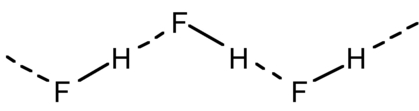
This can dissociate to give {tex} \mathrm{HF}_{2}^{-} {/tex} ion.
If we add K+ to {tex} \mathrm{HF}_{2}^{-} {/tex} ion, we get KHF2.
Due to the absence of hydrogen bonding in HCl, {tex} \mathrm{HCl}_{2}^{-} {/tex} ion is not formed.
Hence, KHCI2 does not exist.
Therefore, KHF2 exists but KHCl2 does not exist.
Posted by Rupal ???? 6 years, 8 months ago
- 1 answers
Sia ? 6 years, 8 months ago
NO
Number of electrons = 15
Electronic configuration = {tex} \sigma \mathrm{1s}^{2}, \sigma^{*} \operatorname{1s}^{2}, \sigma 2 s^{2}, \sigma^{*} 2 s^{2}, \sigma 2 p_{z}^{2}, {/tex}{tex} \pi 2 p_{x}^{2}=\pi 2 p_{y}^{2}, \pi^{*} 2 p_{x}^{1} {/tex}
Bond order = {tex}\frac {1} {2}{/tex}(10 - 5) = 2.5
Magnetic property = Paramagnetic.
NO+
Number of electron = 14
Electronic configuration = {tex} \sigma \mathrm{1s}^{2}, \sigma^{*} \mathrm{1s}^{2}, \sigma 2 s^{2}, \sigma^{*} 2 s^{2}, {/tex}{tex} \sigma 2 p_{z}^{2}, \pi 2 \rho_{x}^{2}=\pi 2 p_{y}^{2} {/tex}
Bond order = {tex}\frac {1} {2}{/tex}(10 - 4) = 3
Magnetic property = Diamagnetic.
{tex} \mathrm{N} O^{2+} {/tex}
Number of electrons = 13
Electronic configuration = {tex} \sigma \mathrm{1s}^{2}, \sigma^{*} \mathrm{1s}^{2}, \sigma 2 s^{2}, \sigma^{*} 2 s^{2}, {/tex}{tex} \sigma 2 p_{z}^{2}, \pi 2 \rho_{x}^{2}=\pi 2 p_{y}^{1} {/tex}
Bond order = {tex}\frac {1} {2}{/tex} (9 - 4) = 2.5
Magnetic property = Paramagnetic
NO-
Number of electrons = 16
Electronic configuration = {tex} \sigma \mathrm{1s}^{2}, \sigma^{*} \mathrm{1s}^{2}, \sigma 2 s^{2}, \sigma^{*} 2 s^{2}, {/tex}{tex} \pi 2 p_{x}^{2}=\pi 2 p_{y}^{2}, \pi^{*} 2 p_{x}^{2} {/tex}
Bond order = {tex}\frac {1} {2}{/tex}(10 - 6) = 2
Magnetic property = Diamagnetic
Since {tex} \mathrm{NO}^{+} {/tex} has the highest bond order and therefore, it has the shortest bond length.
Posted by Rakshaka P 6 years, 8 months ago
- 1 answers
Yash Goswami????? 6 years, 8 months ago
Posted by Abhishek Haldar 6 years, 8 months ago
- 0 answers
Posted by Bijender Singh 6 years, 8 months ago
- 0 answers
Posted by Abhay Kumar 6 years, 8 months ago
- 1 answers
Sia ? 6 years, 8 months ago
Every chemical element has one or more radioactive isotopes. For example, hydrogen, the lightest element, has three isotopes with mass numbers 1, 2, and 3.
Posted by Sakshi Goenka? 6 years, 8 months ago
- 1 answers
Ayush Vishwakarma?? 6 years, 8 months ago
Posted by Shamil Cm 6 years, 8 months ago
- 0 answers
Posted by Shamil Cm 6 years, 8 months ago
- 1 answers
Maheswari Nithyanandam 6 years, 8 months ago
Posted by Jiya Arora????? 6 years, 8 months ago
- 4 answers
Ayush Vishwakarma?? 6 years, 8 months ago

myCBSEguide
Trusted by 1 Crore+ Students

Test Generator
Create papers online. It's FREE.

CUET Mock Tests
75,000+ questions to practice only on myCBSEguide app

Sia ? 6 years, 8 months ago
700 grams iron can be obtained by the reduction of 1 kg of Fe2o3.
2Thank You