
Ask questions which are clear, concise and easy to understand.
Ask QuestionPosted by Patel Jay 6 years, 6 months ago
- 0 answers
Posted by Binay Pradhan 6 years, 6 months ago
- 1 answers
Sia ? 6 years, 6 months ago
In chemical nomenclature, the IUPAC nomenclature of organic chemistry is a systematic method of naming organic chemical compounds as recommended by the International Union of Pure and Applied Chemistry (IUPAC). There is also an IUPAC nomenclature of inorganic chemistry.

Posted by Biplab Kaibarta 6 years, 6 months ago
- 1 answers
Sia ? 6 years, 6 months ago
The empirical formula of the above compound is CH2Cl. empirical formula mass is 12 + (1x2) + 35.5 = 49.5
n= molecular mass/ empirical formula mass =98.96/49.5 = 2
Hence molecular formula is C2H4Cl2
Posted by Sudhanshu Pandit 6 years, 6 months ago
- 3 answers
Yogita Ingle 6 years, 6 months ago
Orbit :
An orbit is a well defined circular path around the nucleus in which the electrons revolve.
It represents the planar motion of an electron around the nucleus.
Orbital :
1.An 39 orbital is the three dimension space around the nucleus within which the probability of finding an electron is maximum (upto 90%).
2.It 14 represents the three dimensional motion of an electron around the nucleus.
Arindam Maity 6 years, 6 months ago
Samaksh Rastogi 6 years, 6 months ago
Posted by Anterpal Singh 6 years, 6 months ago
- 2 answers
Gaurav Seth 6 years, 6 months ago
Answer : The amount of carbon dioxide formed is, 76.93 g
Solution : Given,
Mass of methane = 80 g
Molar mass of methane = 16.042 g/mole
Molar mass of carbon dioxide = 14.026 g/mole
First we have to calculate the moles of .
Now we have of calculate the moles of carbon dioxide.
The balanced chemical reaction is,
Form the reaction, we conclude that
1 mole of methane react to give 1 mole of carbon dioxide
5.485 moles of methane react to give 5.485 moles of carbon dioxide
Now we have to calculate the mass of carbon dioxide.
Mass of carbon dioxide = Moles of carbon dioxide × Molar mass of carbon dioxide
Mass of carbon dioxide = 5.485 moles × 14.026 g/mole = 76.93 g
Therefore, the amount of carbon dioxide formed is, 76.93 g
Posted by Priya Dharshini 6 years, 6 months ago
- 2 answers
Aditya Narayan Singh 6 years, 6 months ago
Tannu Sharma 6 years, 6 months ago
Posted by Vanshika Sharma 6 years, 6 months ago
- 2 answers
Aayan Hussain 6 years, 6 months ago
Posted by Sms Kushwaha 6 years, 6 months ago
- 1 answers
Gaurav Seth 6 years, 6 months ago
1 mole NaOH is equivalent to 40 gm of NaOH.
Molality can be defined as the number of moles of solute in 1000 gm of solution.
Thus 5 molal aqueous NaOH solution contains, [ (5 x 40) = 200 ] gm NaOH.
Thus water present in the solution = (1000 - 200) = 800 gm
Moles of water present = (800 / 18) = 44.45
Thus the mole fraction of NaOH = (moles of NaOH / Total moles in solution) = (5 / 5 + 44.45) = 0.101
Posted by Shamshad Banu Betageri 6 years, 6 months ago
- 2 answers
Posted by Mohammed Shafik Mansuri 6 years, 6 months ago
- 2 answers
Harender Singh 6 years, 6 months ago
Posted by Yash Goswami????? 6 years, 6 months ago
- 9 answers
Himanshu Yadav 6 years, 6 months ago
Yash Goswami????? 6 years, 6 months ago
Posted by Mahdi Habibullah 6 years, 6 months ago
- 1 answers
Gaurav Seth 6 years, 6 months ago
Covalent bond: The bond formed by mutual sharing of valency electrons in order to get stable electronic configuration of nearest inert gas is called covalent bond. Generally this bond is formed between non metals.
Based on type of atoms participated in the bonding, covalent bond is classified into two types. They are (i) polar covalent bonding
(ii) Non-polar covalent bonding
(i) Polar covalent bond: The bond formed between atoms of different electronegativity is called polar covalent bond. Ex: HCl, HF, HBr, H₂O, NH₃…etc
(ii) Non –polar covalent bond: the bond formed between atoms of similar electronegativity is called non-polar covalent bond. Ex: H₂, O₂, N₂, Cl₂…etc.
In a covalent bond shared pair of electrons is known as Bond pair. Bond pair is represented by a line.
Based on number of electrons shared between the atoms the covalent bonds are classified into three types: Single covalent bond, Double covalent bond and Triple covalent Bond.
Examples of Covalent Bond:
Hydrogen molecule is formed by the sharing of one electron pair (single bond) between two hydrogen atoms.
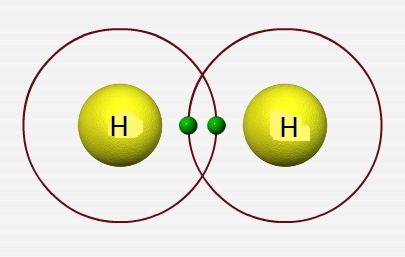
Oxygen molecule is formed by the sharing two electron pairs (double bond) between two oxygen atoms.

Nitrogen molecule is formed by the sharing of three electron pairs (triple bond) between two nitrogen atoms.

Posted by Roman Reigns 6 years, 6 months ago
- 7 answers
Posted by Mohammed Shafik Mansuri 6 years, 6 months ago
- 1 answers
Harender Singh 6 years, 6 months ago
Posted by Mohammed Shafik Mansuri 6 years, 6 months ago
- 3 answers
Khushi Rajput 6 years, 6 months ago
Khushi Rajput 6 years, 6 months ago
Mehak Gautam 6 years, 6 months ago
Posted by Nishant Shishodia 6 years, 6 months ago
- 1 answers
Mehak Gautam 6 years, 6 months ago
Posted by Bhavishya Kumar 6 years, 6 months ago
- 6 answers
Rashi Vashist??❤ 6 years, 6 months ago
Bhavishya Kumar 6 years, 6 months ago
Posted by Sonu Kumar 6 years, 6 months ago
- 3 answers
Harender Singh 6 years, 6 months ago
Aditi Rani 6 years, 6 months ago
Surya Thambirajan 6 years, 6 months ago
Posted by Tarannum Mahida 6 years, 6 months ago
- 1 answers
Mehak Gautam 6 years, 6 months ago
Posted by Deve Gowda T C 6 years, 6 months ago
- 2 answers
Mehak Gautam 6 years, 6 months ago
Posted by Afrin Khalifa 6 years, 6 months ago
- 1 answers
Yogita Ingle 6 years, 6 months ago
Avogadro Law
- It states that equal volumes of all gases under the same conditions of temperature and pressure
contain equal number of molecules. Mathematically,
V ∞ n
V = k4n
- The number of molecules in one mole of a gas = 6.022 ×10²³
- This is termed as Avogadro constant.
Posted by Nandana S Krishnan 6 years, 6 months ago
- 2 answers
Sia ? 6 years, 6 months ago
N2>N2->N2+.
Nitrogen is an electronegative atom. It can manage an added negative charge easily.
But N2 + will be highly unstable.
Obviously N2 is most stable in given options.
so above order is correct order of their stability.
Posted by 5O75O8 Kulwant Singh Kingra 6 years, 6 months ago
- 2 answers
Om Vedant 6 years, 6 months ago
Posted by Gurwinder Singh 6 years, 6 months ago
- 1 answers
Mehak Gautam 6 years, 6 months ago

myCBSEguide
Trusted by 1 Crore+ Students

Test Generator
Create papers online. It's FREE.

CUET Mock Tests
75,000+ questions to practice only on myCBSEguide app
