
Ask questions which are clear, concise and easy to understand.
Ask QuestionPosted by Aman Verma 5 years, 9 months ago
- 3 answers
Yogita Ingle 5 years, 9 months ago
Stoichiometry as the calculation of products and reactants in a chemical reaction. It is basically concerned with numbers.
Stoichiometry helps us determine how much substance is needed or is present. Things that can be measured are;
- Reactants’ and Products mass
- Molecular weight
- Chemical equations
- Formulas
Posted by Pari Agrawal 5 years, 9 months ago
- 1 answers
Meghna Thapar 5 years, 9 months ago
VSEPR notation gives a general formula for classifying chemical species based on the number of electron pairs around a central atom. Note, however, that not all species have the same molecular geometry. For example, carbon dioxide and sulfur dioxide are both species, but one is linear and the other is bent. It is the relative arrangement of bonded atoms in a molecule. The way in which the bonded atoms direct themselves around the central atom is explained on the basis of this theory.
Posted by ꧁༺★ṖŕīᑎƇɛ {Ƭĥɛ Ŀ❤Ѵɛ Ɠʊŕʊ}★༺꧂ ?? 5 years, 9 months ago
- 4 answers
꧁༺★ṖŕīᑎƇɛ {Ƭĥɛ Ŀ❤Ѵɛ Ɠʊŕʊ}★༺꧂ ?? 5 years, 9 months ago
Posted by Royal Thakur 5 years, 9 months ago
- 3 answers
Posted by Ram Shukla 5 years, 9 months ago
- 1 answers
Gaurav Seth 5 years, 9 months ago
Ans is B
If two compounds have the same empirical formula but different molecular formula, they must have different molecular weights.
For example, CH2O and C6H12O6 have the same empirical formula but different molecular formula, they have different molecular weights.
Posted by Royal Thakur 5 years, 9 months ago
- 3 answers
Royal Thakur 5 years, 9 months ago
Posted by Royal Thakur 5 years, 9 months ago
- 4 answers
Royal Thakur 5 years, 9 months ago
Royal Thakur 5 years, 9 months ago
Royal Thakur 5 years, 9 months ago
Posted by Faizan Saifi 5 years, 9 months ago
- 1 answers
Yogita Ingle 5 years, 9 months ago
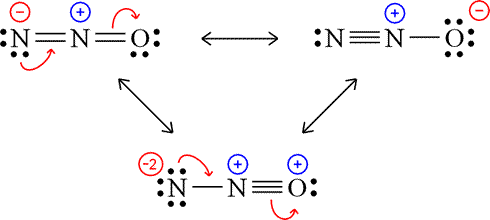
Dinitrogen monooxide, or N2O, has three resonance structures, out of which one is a major contributor and one is a minor contributor.
The N2O molecule has a total number of 18 valence electrons - 6 from nitrogen and 6 from each oxygen atom.
The three resonance structures for dinitrogen monoxide are
Posted by ꧁༺★ṖŕīᑎƇɛ {Ƭĥɛ Ŀ❤Ѵɛ Ɠʊŕʊ}★༺꧂ ?? 5 years, 9 months ago
- 4 answers
Yogita Ingle 5 years, 9 months ago
Mole fraction represents the number of molecules of a particular component in a mixture divided by the total number of moles in the given mixture. It’s a way of expressing the concentration of a solution.
Mole Fraction formula
The molar fraction can be represented by X. If the solution consists of components A and B, then the mole fraction is,
Mole fraction of solute = Moles of solute/Moles of solute + moles of solvent
Posted by Mahi Rajput 5 years, 9 months ago
- 5 answers
? Royal Thakur ? 5 years, 9 months ago
Posted by Hardeep Buttar 5 years, 9 months ago
- 2 answers
Yogita Ingle 5 years, 9 months ago
| Emission Spectra | Absorption Spectra |
| Produced when atoms release energy | Produced when atoms absorb energy |
| Comprise of coloured lines in the spectrum | Comprise of dark lines or gaps in the spectrum |
| Is in helpful in figuring out the composition of a certain matter | Can be used to figure out the ability of certain objects to retian heat and its absorption level |
| The type of photons emitted is helpful in figuring out the kind of elements the substance is made of as each element radiates a different amount of energy and has a unique emission level | The wavelengths of light absorbed is helpful in figuring out the quantity of substances in the sample. |
Posted by Depender Kumar 5 years, 9 months ago
- 1 answers
Meghna Thapar 5 years, 9 months ago
The molarity is calculating the moles of solute per volume of solution that is taken in litre. It has to analyse with moles of NaCl is equal to 5.85/58.5=0.1.
Molarity varies with temperature and so we have to specify this for the answer to be accurate. Let’s go with 20˚C. Also molarity is specified per litre of the solution and so we’ll need to work out the solution volume at 20˚C.
Now the atomic masses of Sodium and Chlorine are 22.99 and 35.45 respectively, so the molecular mass of NaCl is 58.44g. With 5.85g of NaCl we therefore have:
5.8558.44=0.1001 mol5.8558.44=0.1001 mol
Meanwhile 200ml of water has a mass of 200g and so the mass of the solution is 5.85+200=205.85g.
Posted by Arman Yaduvanshi 5 years, 9 months ago
- 1 answers
Yogita Ingle 5 years, 9 months ago
According to Planck’s quantum theory,
- Different atoms and molecules can emit or absorb energy in discrete quantities only. The smallest amount of energy that can be emitted or absorbed in the form of electromagnetic radiation is known as quantum.
- The energy of the radiation absorbed or emitted is directly proportional to the frequency of the radiation.
Posted by Sm .. 5 years, 9 months ago
- 3 answers
Shivansh Lavaniya 5 years, 9 months ago
Posted by ? Royal Thakur ? 5 years, 9 months ago
- 4 answers
? Royal Thakur ? 5 years, 9 months ago
? Royal Thakur ? 5 years, 9 months ago
Posted by ? Royal Thakur ? 5 years, 9 months ago
- 5 answers
? Royal Thakur ? 5 years, 9 months ago
? Royal Thakur ? 5 years, 9 months ago
Posted by ? Royal Thakur ? 5 years, 9 months ago
- 4 answers
? Royal Thakur ? 5 years, 9 months ago
? Royal Thakur ? 5 years, 9 months ago
Posted by ? Royal Thakur ? 5 years, 9 months ago
- 5 answers
? Royal Thakur ? 5 years, 9 months ago
Posted by ꧁༺★ṖŕīᑎƇɛ {Ƭĥɛ Ŀ❤Ѵɛ Ɠʊŕʊ}★༺꧂ ?? 5 years, 9 months ago
- 2 answers
Posted by Subham Soni 5 years, 9 months ago
- 5 answers
Posted by Manisha Dhami 5 years, 9 months ago
- 1 answers
Pk . 5 years, 9 months ago
Posted by ꧁༺★ṖŕīᑎƇɛ {Ƭĥɛ Ŀ❤Ѵɛ Ɠʊŕʊ}★༺꧂ ?? 5 years, 9 months ago
- 2 answers
Posted by ꧁༺★ṖŕīᑎƇɛ {Ƭĥɛ Ŀ❤Ѵɛ Ɠʊŕʊ}★༺꧂ ?? 5 years, 9 months ago
- 5 answers
Posted by Queen.......... ? 5 years, 9 months ago
- 2 answers
Posted by Queen.......... ? 5 years, 9 months ago
- 0 answers
Posted by Sm .. 5 years, 9 months ago
- 5 answers
Shakir Shaikh 5 years, 9 months ago
Posted by Damini Devi 5 years, 9 months ago
- 1 answers
Gaurav Seth 5 years, 9 months ago
Van der Waals radius
It Is defined as one half the distance between the nuclei of two identical non bonded isolated atoms or two adjacent identical atoms belonging to two
neighbouring molecules of an element in the solid
state.
The magnitude of the van der Waal radius depends
upon the packing of the atoms when the element is
in the solid state.
For Example:The inter nuclear distance between two
adjacent chlorine atoms of the two neighbouring
molecules in the solid state is 360 pm. The van der
waals radius of chlorine atom is 180 pm.
The inter nuclear distance between two adjacent hydrogen atoms of the two neighbouring molecules
in the solid state 240 pm. The van der Waals radius is
120 pm

myCBSEguide
Trusted by 1 Crore+ Students

Test Generator
Create papers online. It's FREE.

CUET Mock Tests
75,000+ questions to practice only on myCBSEguide app

Aman Chauhan 5 years, 9 months ago
0Thank You