
Ask questions which are clear, concise and easy to understand.
Ask QuestionPosted by Vipul Kumar 7 years, 1 month ago
- 1 answers
Posted by Raj Raunak 7 years, 1 month ago
- 1 answers
Meghna Thapar 6 years, 1 month ago
- First Law of Motion:
Newton’s first law of motion states that a body at rest will remain at rest, and a body in motion will continue in motion in a straight line with a uniform speed, unless it is compelled by an external force to change its state of rest or of uniform motion.
All objects resist a change in their state of motion. The tendency of undisturbed objects to stay at rest or to keep moving with the same velocity is called inertia. This is why, the first law of motion is also known as the law of inertia. We tend to remain at rest with respect to the seat until the drives applies a braking force to stop the motorcar. With the application of brakes, the car slows down but our body tends to continue in the same state of motion because of its inertia. A sudden application of brakes may thus cause injury. Safety belts are worn to prevent such accidents as they exert a force on our body to make the forward motion slower. When we are standing in a bus and the bus begins to move suddenly we tend to fall backwards because the sudden start of the bus brings motion to the bus as well as to our feet in contact with the floor of the bus. But the rest of our body opposes this motion because of its inertia.
When a motorcar makes a sharp turn at a high speed, we tend to get thrown to one side due to the law of inertia. We tend to continue in our straight-line motion.
- Second Law of Motion:
The second law of motion states that the rate of change of momentum of an object is proportional to the applied unbalanced force in the direction of force.
The quantity of motion in a body depends on the product of mass and velocity of the body termed as momentum.
The momentum (p) of a body is defined as the product of its mass (m) and velocity (v) and has the same direction as that of the velocity. Its SI unit is kilogram metre per second (kg m s−¹).
Momentum = mass × velocity
p = m × v
Momentum has both magnitude as well as direction; hence it is a vector quantity.
Momentum of a body at rest is zero.
- Mathematical Formulation of Second Law of Motion:
Suppose an object of mass, m is moving along a straight line with an initial velocity, u. It is uniformly accelerated to velocity, v in time, t by the application of a constant force, F throughout the time, t. The initial and final momentum of the object will be, p1 = mu and p2 = mv respectively.
The change in momentum ∝ p2 – p1
∝ mv – mu
∝ m × (v – u).
The rate of change of momentum ∝ m × (v – u)/t
Or, the applied force,
F ∝ m × (v – u)/t
F = km × (v – u)/t
= kma
Here, a = [(v – u)/t ] is the acceleration, which is the rate of change of velocity. The quantity, k is a constant of proportionality.
The SI unit of mass and acceleration are kg and ms-2.
One unit of force is defined as the amount that produces an acceleration of 1 ms-2 in an object of 1 kg mass.
1 unit of force = k × (1 kg) × (1 ms-2).
Posted by Raj Raunak 7 years, 1 month ago
- 1 answers
Posted by Janhavi Chavan 7 years, 1 month ago
- 1 answers
Meghna Thapar 6 years, 1 month ago
In some organisms like bacteria, the nuclear region of the cell may be poorly defined due to the absence of a nuclear membrane. Such an undefined nuclear region containing only nucleic acids is called a nucleoid. Such organisms, whose cells lack a nuclear membrane, are called prokaryotes. Organisms with cells having a nuclear membrane are called eukaryotes. Prokaryotic cells also lack most of the other cytoplasmic organelles present in eukaryotic cells.
Posted by Alok Ray 7 years, 1 month ago
- 2 answers
Posted by Prithvi S 7 years, 1 month ago
- 1 answers
Posted by Tashi Verma 7 years, 1 month ago
- 1 answers
Gaurav Seth 7 years, 1 month ago
A suspension is a heterogeneous mixture in which the solute particles do not dissolve but remain suspended throughout the bulk of the medium. Particles of a suspension are visible to the naked eye.
Properties of a Suspension:
1.) Suspension is a heterogeneous mixture.
2.) The particles of a suspension can be seen by the naked eye.
3.) The particles of a suspension scatter a beam of light passing through it and make its path visible.
4.) The solute particles settle down when a suspension is left undisturbed, that is, a suspension is unstable. They can be separated from the mixture by the process of filtration.
Posted by Tashi Verma 7 years, 1 month ago
- 1 answers
Gaurav Seth 7 years, 1 month ago
If the size of the particles of the solute (also called dispersed phase) is between 1 nm and 100 nm, then these are called colloids. Their solutions are known as colloidal solutions. The colloids exhibit the following characteristic properties:
(i) Brownian motion. Colloidal particles move at random in zig-zag paths like gas particles. This is called Brownian motion. This type of motion is caused due to the collisions between the particles of the dispersion medium and the colloidal particles.
(ii) Tyndall effect. When strong beam of light is passed through a true solution taken in a beaker placed in a dark room, the path of light through the solution is dark. But if the light is passed through a colloidal solution under conditions as above, the path of light through the colloidal solution becomes visible. This is called Tyndall effect. The colloidal particles become illuminated because they scatter the light falling on them in all directions.
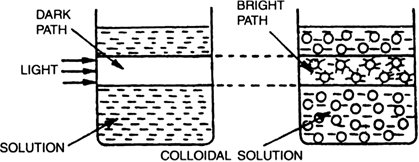
Fig. Tyndall effect.
(iii) Electrophoresis: When an electric current is passed through a colloidal solution, the particles move either towards the positive or negative electrode. This phenomenon is known as electrophoresis. By the direction of the movement of colloidal particles, we can know the nature of the charge on them.
Posted by Naman Karwasra 7 years, 1 month ago
- 2 answers
Ritu Jain 7 years, 1 month ago
Posted by Aman Khan 7 years, 1 month ago
- 2 answers
Ayush Tiwari 7 years, 1 month ago
Krishan Kumar Yadav 7 years, 1 month ago
Posted by Krishan Kumar Yadav 7 years, 1 month ago
- 0 answers
Posted by Naman Karwasra 7 years, 1 month ago
- 0 answers
Posted by Krishan Kumar Yadav 7 years, 1 month ago
- 2 answers
Akshata Kumar 7 years, 1 month ago
Yazhini Yazhu 5 years, 11 months ago
Posted by Chinmay Chinnu 7 years, 1 month ago
- 3 answers
Akanksha Kumari 7 years, 1 month ago
Posted by Nitya Tamminidi 7 years, 1 month ago
- 2 answers
Posted by Suyash Walke 7 years, 1 month ago
- 2 answers
Ayush Tiwari 7 years, 1 month ago
Amidhi Jain 7 years, 1 month ago
Posted by Isha Singh 7 years, 1 month ago
- 1 answers
Nishant Lamba 7 years, 1 month ago
Posted by Chittaranjan Saikia 7 years, 1 month ago
- 2 answers
Posted by Ansh Singh 7 years, 1 month ago
- 1 answers
Om Singh 7 years, 1 month ago
Posted by Kuni Sahu 7 years, 1 month ago
- 1 answers
Posted by Nandini Rani 7 years, 1 month ago
- 1 answers
Yogita Ingle 7 years, 1 month ago
Tincture of iodine or iodine tincture is an antiseptic, it is also called weak iodine solution. Usually 2–7% elemental iodine, along with potassium iodide or sodium iodide, dissolved in a mixture of ethanol and water. Antiseptics are used to kill the animate micro organisms that may be pathogenic or may cause disease.It is used in skin infection.
Posted by Shiek Azmat 7 years, 1 month ago
- 1 answers
Yogita Ingle 7 years, 1 month ago
Red blood cells (RBCs) : RBCs are the biconcave cells; also known as erythrocytes. RBCs contain the iron-rich protein called hemoglobin; give blood its red color. RBCs are most copious blood cell produced in bone marrows. Their main function is to transport oxygen from and to various tissues and organs.
White blood cells (WBCs) : Leucocytes are the colorless blood cells. They are colorless because it is devoid of hemoglobin. They further classified as granulocytes and agranulocytes. WBCs mainly contribute to immunity and defense mechanism.
Platelets: Thrombocytes are specialized blood cells produced from bone marrow. Platelets come into play when there is bleeding or hemorrhage.They help in clotting and coagulation of blood. Platelets help in coagulation during a cut or wound.
Posted by Apna Idea 7 years, 1 month ago
- 1 answers
Yogita Ingle 7 years, 1 month ago
Nucleoid is the undefined nuclear region containing only nucleic acids, in the prokaryotic cells. It is not bounded by a nuclear membrane and lies in direct contact with the cytoplasm. Nucleoid is poorly organised and is small.
Posted by Jatin Chandra 7 years, 1 month ago
- 1 answers
Neha Dixit 7 years, 1 month ago
Posted by Sourabh Singh 7 years, 1 month ago
- 4 answers
Palak Bansal 7 years, 1 month ago
Yogita Ingle 7 years, 1 month ago
Force can also be described intuitively as a push or a pull. A force has both magnitude and direction, making it a vector quantity. It is measured in the SI unit of newtons and represented by the symbol F.
Posted by Amrita Sahoo 7 years, 1 month ago
- 1 answers
Yogita Ingle 7 years, 1 month ago
Desirable agronomic characteristics are:
(i) Tallness and profuse branching are desirable characters for fodder crops.
(ii) Dwarfness is desired in cereals, so that less nutrients are consumed by these crops.
Posted by Ram Chander Rai 7 years, 1 month ago
- 2 answers
Poorvi Jain 7 years, 1 month ago
Yogita Ingle 7 years, 1 month ago
Carl Linnaeus was a Swedish botanist, physician, and zoologist who formalised binomial nomenclature, the modern system of naming organisms. He is known as the "father of modern taxonomy".
Posted by Chithra S Kumar 7 years, 1 month ago
- 2 answers
Poorvi Jain 7 years, 1 month ago
Yogita Ingle 7 years, 1 month ago
Every single animal, from the smallest of insects to the blue whale (largest animal on earth) is classified into various phylum and classes. This classification is the basis of the Animal Kingdom or Kingdom Animalia. All the members of the animal kingdom are called Metazoa.

myCBSEguide
Trusted by 1 Crore+ Students

Test Generator
Create papers online. It's FREE.

CUET Mock Tests
75,000+ questions to practice only on myCBSEguide app

Ramya Nayak Ramya Nayak 7 years, 1 month ago
4Thank You