
Ask questions which are clear, concise and easy to understand.
Ask QuestionPosted by Vivek Anand 7 years, 1 month ago
- 1 answers
Posted by Suresh Kushawaha 7 years, 1 month ago
- 1 answers
Vikas Yadav 7 years, 1 month ago
Posted by Shreya Jat 7 years, 1 month ago
- 2 answers
Posted by Arzoo Hasan 7 years, 1 month ago
- 2 answers
The Ultimate One 7 years, 1 month ago
Yogita Ingle 7 years, 1 month ago
The crust is the outer layer where we live. The thickness is around 0-60 km. It’s a solid rock layer divided into two types:
- Continental crust covers the land and,
- Oceanic crust covers water.
The crust is the most widely studied and understood. Mantle is hotter and capable of flowing. The outer and inner core are much hotter with great pressures that you can be squeezed into a ball smaller than a marble if you are able to go in the center of the Earth.
Posted by Himanshu Ahuja 7 years, 1 month ago
- 4 answers
Posted by Manpreet Singh 7 years, 1 month ago
- 2 answers
Posted by Owais Khan 7 years, 1 month ago
- 3 answers
Yogita Ingle 7 years, 1 month ago
Mass per unit volume of a substance is called its density. It it a measure of how closely the particles of the substance are packed.
Density = Mass / Volume
Prabhat Singh 7 years, 1 month ago
Posted by Rajeev Mahato 7 years, 1 month ago
- 1 answers
Meghna Thapar 6 years, 1 month ago
As the plant grows older, the outer protective tissue, epidermis undergoes certain changes. A strip of secondary meristem, called phellogen or cork cambium replaces epidermis of stem. Cells on the outside are cut off from this layer. This forms the several-layer thick cork or the bark of the tree. Cells of cork are dead and compactly arranged without intercellular spaces. They also have a chemical called suberin in their walls that makes them impervious to gases and water.
Posted by Sam T.V. And Gamers Clash 7 years, 1 month ago
- 1 answers
Ayus Agarwal 7 years, 1 month ago
Posted by Sheetal Chauhan 7 years, 1 month ago
- 1 answers
Posted by ??? ???? 7 years, 1 month ago
- 1 answers
Gaurav Seth 7 years, 1 month ago
According to Bohr's theory:
(i) The atom consists of a small (positively charged) nucleus at its center.
(ii) The whole mass of the atom is concentrated in the nucleus and the volume of the nucleus is smaller than the volume of the atom by a ratio of about 1 : 105.
(iii) All the protons and neutrons of the atom are contained in the nucleus.

(iv) The electrons of the atom revolve around the nucleus in definite circular paths known as orbits or which are designated as K, L, M, N etc. or numbered as (n) = 1, 2, 3, 4 etc. outward from the nucleus.
(v) Each orbit is associated with a fixed amount of energy. Therefore, these orbits are also known as energy levels or energy shells.
(vi) The energy of the atom changes when an electron jumps from one state (energy level) to another state (energy level). As long as an electron remains in a particular orbit, it does not lose or gain energy.
Posted by ??? ???? 7 years, 1 month ago
- 1 answers
Gaurav Seth 7 years, 1 month ago
Rutherford model of an atom
1)An atom consist of positively charged,dense and very small nucleus containing protons and neutrons.The entire mass of an atom is concentrated in the nucleus.
2)The nucleus is surrounded by negatively charged electrons.the electrons are revolving around the nucleus in circular paths at very high speed.These circular paths of the electrons are called orbits.
3)An atom is electrically neutral because the number of protons and electrons is equal.
4)The size of nucleus is very small as compared to size of atom.
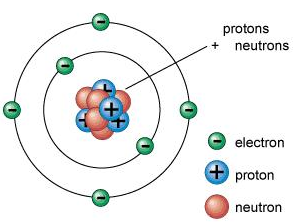
Drawbac
Posted by ??? ???? 7 years, 1 month ago
- 1 answers
Gaurav Seth 7 years, 1 month ago
Characteristic features of Thomson model of an atom are:
(i) An atom consists of a positively charged sphere and the electrons are embedded in it.
(ii) The negative and positive charges are equal in magnitude. So, the atom as a whole is electrically neutral.
Posted by Yogesh Yadav 7 years, 1 month ago
- 0 answers
Posted by Tarun Kumar 7 years, 1 month ago
- 1 answers
??? ???? 7 years, 1 month ago
Posted by Tarun Kumar 7 years, 1 month ago
- 1 answers
Priyam Soni 7 years, 1 month ago
Posted by Sonty Jaiswal 7 years, 1 month ago
- 1 answers
Yogita Ingle 7 years, 1 month ago
Linear momentum is the vector quantity and defined as the product of mass of an object, m, and its velocity, v. The letter ‘p’ is applied to express it and used as momentum for short. Please note that the body’s momentum is always in the same direction as its velocity vector. It’s a conserved quantity which means that the total momentum of a system is constant. The units of linear momentum are kg m/s.
The linear momentum formula is given by,
P = m v
Where,
m = mass
v = velocity
Posted by Ab Devillers 7 years, 1 month ago
- 1 answers
Meghna Thapar 6 years, 1 month ago
According to the law of conservation of momentum, the sum of momenta of two objects before collision is equal to the sum of momenta after collision, provided there is no external unbalanced force acting on the objects.
Posted by Vaibhav Thaware 7 years, 1 month ago
- 2 answers
Simarjot Kaur 7 years, 1 month ago
Posted by Pratik Gurung 7 years, 1 month ago
- 2 answers
??? ???? 7 years, 1 month ago
Posted by Anshika Singh 7 years, 1 month ago
- 1 answers
Meghna Thapar 6 years, 1 month ago
Soil is composed of distinct layers. The rotting matter in the soil is called humus. A vertical section through the soil showing the different layers of soil is called soil profile. Soil profile consists of three different layers of soil. Each layer of soil is called a horizon. The three layers of soil in the soil profile are:
- A-horizon or Top-soil: The uppermost horizon is generally dark in colour as it is rich in minerals and humus. The humus makes the soil fertile and provides nutrients to growing plants. This layer is generally soft, porous and can retain more water. The plant roots grow in the top soil. This layer contains many living things like worms, rodents, and moles etc. Bacteria and fungi also occur in top soil. This layer contains lot of dead and decaying matter which makes it the most fertile layer. It is called the topsoil or the A-horizon.
- B-horizon or Subsoil: The layer of soil which is just below the top-soil is called B-horizon. This layer has a lesser amount of humus but more of minerals. This layer is generally harder and more compact and made up of slightly bigger rock particles than that of top-soil. The subsoil is light in color compared to upper layer.
- C-horizon or Sub-stratum: The third layer is the C-horizon, which is made up of small lumps of rocks with cracks and crevices. Below this layer is the bedrock, which is hard and difficult to dig with a spade.

Posted by Technical & Gaming Facts 7 years, 1 month ago
- 1 answers
Posted by Sahil G 7 years, 1 month ago
- 5 answers
??? ???? 7 years, 1 month ago
Simarjot Kaur 7 years, 1 month ago
Posted by Imran Choudhary 7 years, 1 month ago
- 1 answers
Siya Sharma 7 years, 1 month ago
Posted by Ram Sajeevan 7 years, 1 month ago
- 2 answers
Yogita Ingle 7 years, 1 month ago
The postulates of this theory may be stated as follows:
- Matters are composed of very tiny particles called atoms.
- These particles are too small to see and cannot be created or destroyed in a chemical reaction.
- Atoms of a specified element are identical in mass and chemical properties.
- Atoms of different elements have different masses and chemical properties.
- Atoms combine in the ratio of small whole numbers to form compounds.
- The relative number and kinds of atoms are constant in a given compound.
Neelanshi Singh 7 years, 1 month ago
Posted by Zaid Ali 7 years, 1 month ago
- 1 answers
Posted by ??? ???? 7 years, 1 month ago
- 1 answers
Yogita Ingle 7 years, 1 month ago
The postulates of this theory may be stated as follows:
- Matters are composed of very tiny particles called atoms.
- These particles are too small to see and cannot be created or destroyed in a chemical reaction.
- Atoms of a specified element are identical in mass and chemical properties.
- Atoms of different elements have different masses and chemical properties.
- Atoms combine in the ratio of small whole numbers to form compounds.
- The relative number and kinds of atoms are constant in a given compound.
Posted by Siyaram Meena 7 years, 1 month ago
- 1 answers
Posted by ??? ???? 7 years, 1 month ago
- 1 answers
Yogita Ingle 7 years, 1 month ago
- The Green Revolution was a period when the productivity of global agriculture increased drastically as a result of new advances.
- During this time period, new chemical fertilizers and synthetic herbicides and pesticides were created.
- The chemical fertilizers made it possible to supply crops with extra nutrients and, therefore, increase yield.
- The newly developed synthetic herbicides and pesticides controlled weeds, deterred or kill insects, and prevented diseases, which also resulted in higher productivity.
- In addition to the chemical advances utilized during this time period, high-yield crops were also developed and introduced.
- High-yield crops are crops that are specifically designed to produce more overall yield.
- A method known as multiple cropping was also implemented during the Green Revolution and lead to higher productivity.
- Multiple cropping is when a field is used to grow two or more crops throughout the year, so that the field constantly has something growing on it.
- These new farming techniques and advances in agricultural technology were utilized by farmers all over the world, and when combined, intensified the results of the Green Revolution.

myCBSEguide
Trusted by 1 Crore+ Students

Test Generator
Create papers online. It's FREE.

CUET Mock Tests
75,000+ questions to practice only on myCBSEguide app

Meghna Thapar 6 years, 1 month ago
Spirogyra is a filamentous chlorophyte green algae of the order Zygnematales, named for the helical or spiral arrangement of the chloroplasts that is characteristic of the genus.
0Thank You