
Ask questions which are clear, concise and easy to understand.
Ask QuestionPosted by Mukul Dhanjal 8 years, 3 months ago
- 1 answers
Posted by Mhod Arman 8 years, 3 months ago
- 1 answers
Lakshay Arora 8 years, 3 months ago
Posted by Jatin Rao 8 years, 3 months ago
- 1 answers
Kritika Trehan 8 years, 3 months ago
the throwing back by a body or surface of light, heat, or sound without absorbing it.
Posted by Jatin Rao 8 years, 3 months ago
- 1 answers
Kritika Trehan 8 years, 3 months ago
The knowledge of the laws of reflection is a prerequisite to this article. To recap, the laws of reflection state that,
- The angle of reflection of the light reflected from a surface is equal to the angle of incidence at the point of reflection.
- The reflected ray, the incident ray and the point of reflection all lie on the same plane.

Posted by Abhigyan Bhattacharya 8 years, 3 months ago
- 2 answers
Kartik Singh 8 years, 3 months ago
Posted by Ishu Nandan 8 years, 3 months ago
- 1 answers
Kritika Trehan 8 years, 3 months ago
When a sweater is taken off, it gets charged because of friction between the sweater and body, static charge gets accumulated on the sweater. While taking off the sweater, an eletric discharge occurs between sweater and the body. Due to this, we hear a crackling sound.
Posted by Aman Pky 8 years, 3 months ago
- 2 answers
Priya Chaudhary 8 years, 3 months ago
Kritika Trehan 8 years, 3 months ago
he period during which adolescents reach sexual maturity and become capable of reproduction.
Posted by Akanksha Sharma 8 years, 3 months ago
- 0 answers
Posted by Akanksha Sharma 8 years, 3 months ago
- 1 answers
Kritika Trehan 8 years, 3 months ago
Sound waves travel into the ear canal until they reach the eardrum. The eardrum passes the vibrations through the middle ear bones or ossicles into the inner ear. The inner ear is shaped like a snail and is also called the cochlea. Inside the cochlea, there are thousands of tiny hair cells. Hair cells change the vibrations into electrical signals that are sent to the brain through the hearing nerve. The brain tells you that you are hearing a sound and what that sound is.
<a href="http://www.dangerousdecibels.org/virtualexhibit/2howdowehearb.html">Take a look inside your ear!
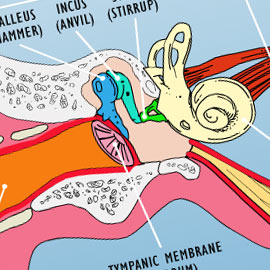 </a>
</a>
Each hair cell has a small patch of stereocilia sticking up out of the top it. Sound makes the stereocilia rock back and forth. If the sound is too loud, the stereocilia can be bent or broken. This will cause the hair cell to die and it can no longer send sound signals to the brain. In people, once a hair cell dies, it will never grow back. The high frequency hair cells are most easily damaged so people with hearing loss from loud sounds often have problems hearing high pitched things like crickets or birds chirping.
Posted by Sarvesh Ninama 8 years, 3 months ago
- 1 answers
Varun Banda 8 years, 3 months ago
In boys, under the influence of hormones (testosterone), larynx grows prominently, vocal cords become longer and thicker, causing the voice to become hoarse.
Posted by Angel R 8 years, 3 months ago
- 1 answers
Varun Banda 8 years, 3 months ago
A force is any interaction that, when unopposed, will change the motion of an object. A force can cause an object with mass to change its velocity (which includes to begin moving from a state of rest), i.e., to accelerate. Force can also be described intuitively as a push or a pull. SI unit: newton (N)
Posted by Sarvesh Ninama 8 years, 3 months ago
- 1 answers
Kritika Trehan 8 years, 3 months ago
In boys, under the influence of hormones, larynx grows prominently, vocal cords longer and thicker, causing the voice to become hoarse.
Posted by Ashish Kumar 8 years, 3 months ago
- 0 answers
Posted by Bipin Kumar 8 years, 3 months ago
- 1 answers
Posted by Gagan Chaudhary 8 years, 3 months ago
- 1 answers
Kritika Trehan 8 years, 3 months ago
<font face="Times New Roman, Times, serif"><font size="+1">There are two types of photoreceptors in the human retina, rods and cones.</font></font>
<font face="Times New Roman, Times, serif"><font size="+1">Rods are responsible for vision at low light levels (scotopic vision). They do not mediate color vision, and have a low spatial acuity.</font></font>
<font face="Times New Roman, Times, serif"><font size="+1">Cones are active at higher light levels (photopic vision), are capable of color vision and are responsible for high spatial acuity. The central fovea is populated exclusively by cones. There are 3 types of cones which we will refer to as the short-wavelength sensitive cones, the middle-wavelength sensitive cones and the long-wavelength sensitive cones or S-cone, M-cones, and L-cones for short.</font></font>
<font face="Times New Roman, Times, serif"><font size="+1">The light levels where both are operational are called mesopic.</font></font>
Posted by Shruti Zade 8 years, 3 months ago
- 0 answers
Posted by Akshit A 8 years, 3 months ago
- 1 answers
Posted by Ankita Nigam 8 years, 3 months ago
- 0 answers
Posted by Gagan Chaudhary 8 years, 3 months ago
- 1 answers
Bhumika Gulati 8 years, 3 months ago
Posted by Yashwanth Hs 8 years, 3 months ago
- 0 answers
Posted by Chandana Chandu 8 years, 3 months ago
- 1 answers
Posted by Manas Agrawal 8 years, 3 months ago
- 1 answers
Posted by Khalid Raza 8 years, 3 months ago
- 1 answers
Posted by Arpita Sehrawat 8 years, 3 months ago
- 2 answers
Nidhishree Deshpande 8 years, 3 months ago
Posted by Ncert Sahil 8 years, 3 months ago
- 2 answers
Gurdev Singh 8 years, 3 months ago
Kruti Satpathy 8 years, 3 months ago
Posted by Chithra Reddy 8 years, 3 months ago
- 1 answers
Posted by Vijay Singh 8 years, 3 months ago
- 2 answers
Bhumika Gulati 8 years, 3 months ago
Posted by Puran Sahu 8 years, 3 months ago
- 1 answers
Kruti Satpathy 8 years, 3 months ago

myCBSEguide
Trusted by 1 Crore+ Students

Test Generator
Create papers online. It's FREE.

CUET Mock Tests
75,000+ questions to practice only on myCBSEguide app

Varun Banda 8 years, 3 months ago
The eardrum, also called the tympanic membrane or myringa.
2Thank You