
Ask questions which are clear, concise and easy to understand.
Ask QuestionPosted by Aesh Mehar 5 years, 7 months ago
- 1 answers
Posted by Aesh Mehar 5 years, 7 months ago
- 1 answers
Yogita Ingle 5 years, 7 months ago
Polar habitats are located on the very top and very bottom of the Earth – the North Pole, which is called the Arctic, and the South Pole, which is the continent of Antarctica. Some parts of polar regions are always frozen, all year round.
Posted by Aesh Mehar 5 years, 7 months ago
- 1 answers
Posted by Ayush Mishra 5 years, 7 months ago
- 1 answers
Posted by Jitul R Pathak 5 years, 7 months ago
- 2 answers
Shivam Singh 5 years, 7 months ago
Posted by Yash Jadhav 5 years, 7 months ago
- 1 answers
Meghna Thapar 5 years, 4 months ago
Alfred Lothar Wegener (1880-1930), who established the theory of continental drift. Photograph courtesy: Alfred Wegener Institute for Polar and Marine Research, Bremer-haven, Germany (AWl). The theory of continental drift is most associated with the scientist Alfred Wegener. In the early 20th century, Wegener published a paper explaining his theory that the continental landmasses were “drifting” across the Earth, sometimes plowing through oceans and into each other.
Posted by Yash Malik 5 years, 7 months ago
- 2 answers
Payal Devnani 5 years, 7 months ago
Yash Malik 5 years, 7 months ago
Posted by Abhay Singh Tomar 5 years, 7 months ago
- 1 answers
Yogita Ingle 5 years, 7 months ago
An alimentary canal and digestive glands are parts of human digestive system. The various parts of the alimentary canal includes mouth, teeth, esophagus, pharynx, stomach, small intestine (duodenum, jejunum and ileum), large intestine, ****. Digestive glands includes salivary glands, pancreas, liver, gastric glands and intestinal glands. Out of these, salivary glands, pancreas and liver are major glands. The main function of salivary gland is to produce saliva which aids in digestion. Hepatic cells of liver secrete bile that pass into the gallbladder through the hepatic ducts. The hepatic duct from the liver and cystic duct from the gallbladder forms the common bile duct. Pancreas secretes the digestive enzymes into the small intestine in the form of pancreatic juice.
Posted by Mohammad Bharmal 5 years, 7 months ago
- 2 answers
Mithun M 5 years, 7 months ago
Abhay Singh Tomar 5 years, 7 months ago
Posted by Jitendra Kumar Bedia 5 years, 7 months ago
- 5 answers
Posted by Pushkala Pagare 5 years, 7 months ago
- 5 answers
?Sooraj Martin? 5 years, 7 months ago
Tejal Patil 5 years, 7 months ago
Gaurav Seth 5 years, 7 months ago
Circular Motion
A round path having the shape of a circle is called circular path. When an object moves along a circular path, it is called circular motion.
(1) The earth moves around the sun in a circular path
(or circular orbit), so the motion of the earth around the sun is circular motion.
(2) Motion of a child in a merry-go-round, and
(3) Motion of pedals of a moving bicycle.
Yogita Ingle 5 years, 7 months ago
Circular motion is described as a movement of an object while rotating along a circular path. Circular motion can be either uniform or non-uniform. During uniform circular motion the angular rate of rotation and speed will be constant while during non-uniform motion the rate of rotation keeps changing.
Some of the most common examples of circular motion include man-made satellite that revolves around the earth, a rotating ceiling fan, a moving car’s wheel, the blades in a windmill, and gears in gas turbines.
Posted by Yashas Laukik 5 years, 7 months ago
- 2 answers
Yogita Ingle 5 years, 7 months ago
A tornadois a violently rotating dark funnel shaped cloud that reached from sky towards ground.
- Diameter of a tornado ranges from few meters to a km.
- It grows bigger by taking dust and anything else near it. Smaller tornadoes can only make dust rotate with itself whereas a bigger tornado can take vehicles or even houses.
- It sucks everything from bottom and throws them out from the top.
- Tornadoes can attain a speed of 300km/hr.
- They can form within cyclones.
Posted by Chaman Deep 5 years, 7 months ago
- 2 answers
Sai Bhonde 5 years, 7 months ago
Yogita Ingle 5 years, 7 months ago
The different types of nutrition in animals include:
- Filter Feeding: obtaining nutrients from particles suspended in water. Commonly used by fish.
- Deposit feeding: obtaining nutrients from particles suspended in the soil. Earthworms use this mode of ingestion.
- Fluid feeding: obtaining nutrients by consuming other organisms’ fluids. Honey bees, mosquitos exhibit this mode of food intake.
- Bulk feeding: obtaining nutrients by eating the whole of an organism. Example: Python.
- Ram feeding and suction feeding: ingesting prey via the fluids around it. This mode of ingestion is usually exhibited by aquatic predators such as bony fish.
Posted by Chaman Deep 5 years, 7 months ago
- 3 answers
Payal Devnani 5 years, 7 months ago
Posted by Archita Prusty 5 years, 7 months ago
- 1 answers
Posted by Saurav Das 5 years, 7 months ago
- 3 answers
Gaurav Seth 5 years, 7 months ago
Salts
- Salt is the product formed from the neutralisation reaction of acids and bases.
- In the reaction between hydrochloric acid and sodium hydroxide the salt formed is sodium chloride.
HCl+NaOH→NaCl+H2O
- Salt can be acidic, basic or neutral in nature.
Posted by Aditya Raj 5 years, 7 months ago
- 5 answers
Gaurav Seth 5 years, 7 months ago
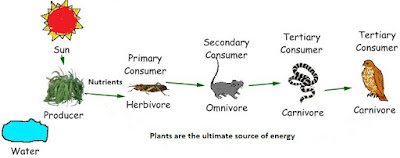
Show with the help of a sketch that the plants are the ultimate source of food.
Answer
The food chain shows that the plant is the ultimate producer. Only plant can produce food and rest of other organisms are directly or indirectly dependent on it.
Posted by Shambhavi Kumari 5 years, 7 months ago
- 1 answers
Gaurav Seth 5 years, 7 months ago
Two components in thallus of lichens are algae & fungi.
● Explanation -
- Lichens are type of symbiotic relationship between algae & fungi.
- Thallus is the vegetative part of lichens.
- It is composed of algae & fungi.
- Based on morphology of thallus, lichens are divided into following types -
- crustose lichens - encrusting
- foliose - leaf-like
- fruticise - finger-like projections
- squamulose - flat overlapping scales
Posted by Barsha Sahoo 5 years, 7 months ago
- 1 answers
Yogita Ingle 5 years, 7 months ago
When a current is switched on through a wire, the wire starts behaving as a magnet. Hence, when a compass needle is placed near the given current carrying wire, it gets influenced by the magnetic effect of electric current and gets deflected from its north- south position.
Posted by Ajay Singh 5 years, 7 months ago
- 3 answers
Ritik Kumar 5 years, 7 months ago
Yogita Ingle 5 years, 7 months ago
Heterotrophic nutrition is the mode of nutrition where the organism is unable to prepare its food and hence, depends upon plants or other organisms for nutrition.
Bacteria, fungi, yeast, cows, dogs, humans are all heterotrophs. They all depend on plants and other animals for their food.
Posted by Ajay Singh 5 years, 7 months ago
- 3 answers
Posted by Abhisant Yadav 5 years, 7 months ago
- 1 answers
Posted by Mohammad Bharmal 5 years, 7 months ago
- 1 answers
Maitrayee Pareek 5 years, 7 months ago
Posted by V Guru Kiran 9B 5 years, 7 months ago
- 0 answers
Posted by Dharshini Pownraj 5 years, 7 months ago
- 2 answers
Gaurav Seth 5 years, 7 months ago
Digestion in humans
- Humans take food through mouth, digest the food and finally the undigested food are removed from the body.
- The food passes from oral cavity and finally the undigested food is defecated through ****.

- It is a complex process involving following steps:
- Ingestion
- Ingestion refers to the intake of food
- Ingestion takes place through Mouth
- Digestion
- Digestion refers to the breakdown of ingested food into simpler forms
- Teeth, Stomach, Small intestine and secretion from various glands help in Digestion
- Absorption
- Absorption refers to the process in which digested food in absorbed in to the body fluids (Blood & lymph)
- Small intestine plays a major role in Absorption
- Assimilation
- Assimilation refers to the process in which absorbed food is transported to different cells of the body
- Egestion
- Egestion refers to the process of removal of undigested food from the body
- Large intestine plays a major role in Egestion
Posted by Akeel Ahmad 5 years, 7 months ago
- 3 answers
Barsha Sahoo 5 years, 7 months ago
Gaurav Seth 5 years, 7 months ago
1. X-Rays are one of the most common uses of radiation in hospitals and pharmacies, providing valuable information to doctors.
2. Radiations are also used for food irradiation. It is the process of using radioactive sources to preserve and sterilize food.
Posted by Sahil Jain 5 years, 7 months ago
- 3 answers
Barsha Sahoo 5 years, 7 months ago
Gaurav Seth 5 years, 7 months ago
Nutrients are replenished in the Soil by adding Fertilisers and manures
When fertilisers and manures are added to the soil in the fields, then the soil gets enriched with nutrients like nitrogen, phosphorus and potassium, etc. The crop plants can then grow well in this soil. Fertilisers and manures provide essential nutrients for the growth of plants so that we get healthy plants.
Posted by Anishka Goel 5 years, 7 months ago
- 2 answers
Yogita Ingle 5 years, 7 months ago
Petroleum is a fossil fuel which got formed by the dead remains of the sea animals. These animals slowly got trapped under soil and clay and more deposits were formed with time. Due to depth, the temperature and pressure raised and over the years they got converted into petroleum oil. Since oil is lighter than water, it did not get mixed with water and got raised to the superficial rocks, which did not allow it to pass through them.
Petroleum is a mixture of various useful substances. Thus, it is refined to separate these useful by-products in petroleum refineries by the process of fractional distillation of petroleum.
Posted by Sanskruti Bhojane 5 years, 7 months ago
- 1 answers
Yogita Ingle 5 years, 7 months ago
An acid is any hydrogen-containing substance that is capable of donating a proton (hydrogen ion) to another substance. A base is a molecule or ion able to accept a hydrogen ion from an acid.
Acidic substances are usually identified by their sour taste. An acid is basically a molecule which can donate an H+ ion and can remain energetically favourable after a loss of H+. Acids are known to turn blue litmus red.

myCBSEguide
Trusted by 1 Crore+ Students

Test Generator
Create papers online. It's FREE.

CUET Mock Tests
75,000+ questions to practice only on myCBSEguide app

?Sooraj Martin? 5 years, 7 months ago
0Thank You