
Ask questions which are clear, concise and easy to understand.
Ask QuestionPosted by Divyanshee Gomango 5 years, 10 months ago
- 2 answers
Meghna Thapar 5 years, 10 months ago
Digestion of food in human beings begins in the mouth. The mouth cavity contains teeth, tongue and salivary glands. The teeth cut the food into small pieces, chew and grind it. This is called physical digestion. Salivary glands produce saliva which mixes with the food. This involves chemical digestion of food. The saliva contains an enzyme called salivary amylase which digests the starch and converts it into maltose sugar. Mouth opens into a small funnel shaped area called pharynx which leads to a long tube called oesophagus. It carries the food down into the stomach. The wall of oesophagus is muscular. When the slightly digested food enters the food pipe, the walls of the oesophagus starts contraction and expansion movements called peristaltic movements which push the food into the stomach. Digestion does not take place in the oesophagus.
The glands present on the walls of the stomach secrete gastric juice that contains hydrochloric acid, the enzyme pepsin and mucus. A small amount of gastric lipase is also present that breaks down the fats present in the food. Gastric juice is acidic due to the presence of HCl which is necessary for the pepsin to become active and converts the proteins into peptones. The mucus protects the stomach walls from HCl. From the stomach, the partially digested food goes into the small intestine through sphincter muscle. Small intestine is divided into two parts: Duodenum and Ileum.
Duodenum receives the secretions of two glands, liver and pancreas through a common duct. Liver secretes bile which is alkaline and contains salts to emulsify the fats (or lipids). The bile secreted by the liver is stored in the gall bladder. Pancreas secretes pancreatic juice which contains trypsin, lipase and pancreatic amylase. Trypsin digests the proteins, lipase emulsifies the fats and pancreatic amylase breaks down the starch. Thus, small intestine is the site of complete digestion of carbohydrates, proteins and fats. The walls of ileum secrete succus entericus which completes the digestion process.
Posted by Divyanshee Gomango 5 years, 10 months ago
- 1 answers
Meghna Thapar 5 years, 10 months ago
Grass eating animals are called ruminant animals. Example – cow. They have special stomach to digest cellulose present in the grass. Their stomach is large and is divided into four compartments.
- Rumen:
- Omasum
- Abomasum
- Reticulum
Rumen is the first and the biggest compartment of a cow’s stomach. It contains cellulose digesting bacteria. When a cow eats grass as food, it does not chew it completely but swallow it and gets stored in the rumen. The bacteria present in the rumen start to digest cellulose and gets partially digested. The partially digested food/grass in the rumen of a cow is called cud. After some time, the cud is brought back into the mouth and is chewed thoroughly. That is why, a cow moves its jaws from side to side and chew continuously even when it is not eating grass.
The process by which the cud is brought back from the stomach to the mouth of the animal and chewed again is called rumination. The animals which chew the cud are called ruminants. When the cud is thoroughly chewed in the mouth of the cow, it is swallowed and goes into the other compartments of the cow’s stomach and then into the small intestine for complete digestion and absorption.
Posted by Divyanshee Gomango 5 years, 10 months ago
- 1 answers
Posted by Pushkal Adlakha 5 years, 10 months ago
- 1 answers
Meghna Thapar 5 years, 10 months ago
Holozoic nutrition: It is that nutrition in which an organism takes the complex organic food materials into its body by the process of ingestion; the ingested food is digested and then absorbed into the body cells of the organism.
Example: Human beings and Paramecium.
Posted by Sunita Kumari 5 years, 10 months ago
- 2 answers
Deeraj Kumar 5 years, 10 months ago
Posted by Bhoomika K 5 years, 10 months ago
- 5 answers
Divyanshee Gomango 5 years, 10 months ago
Pooja Spoliya 5 years, 10 months ago
Akshat Mishra 5 years, 10 months ago
Posted by Bhoomika K 5 years, 10 months ago
- 2 answers
Vaishali Patil 5 years, 10 months ago
Akshat Mishra 5 years, 10 months ago
Posted by Tanesh Mandal 5 years, 10 months ago
- 0 answers
Posted by Tanmay Zende Roll No. 38 5 years, 10 months ago
- 1 answers
Yogita Ingle 5 years, 10 months ago
- Bile is produced in the liver. The bile juice stored in a sac called the gall bladder. It helps in the digestion of fats. It is a greenish-yellow alkaline (basic in nature) liquid, which is stored in the Gall Bladder.
- Bile is secreted into the small intestine where it helps in the digestion of fats(lipids). It actually doesn't digest fats but breaks the fat molecules into smaller pieces to make their digestion easy. This process is called fat emulsification.
Posted by Swati Sinha 5 years, 10 months ago
- 3 answers
Vaishali Patil 5 years, 10 months ago
Yogita Ingle 5 years, 10 months ago
Plants that eat insects are called insectivorous plants. They trap and digest insects. Pitcher plant is the example of an insectivorous plant. The soil of marshy land is deficient in nitrogen.
Plants living in marshy areas do not get nitrogen from the soil. To fulfill their nitrogenous need, they need to eat insects.
Posted by Bharat Chauhan 5 years, 10 months ago
- 1 answers
Posted by Puneet Verma 5 years, 10 months ago
- 1 answers
Meghna Thapar 5 years, 10 months ago
Rumen is the first and the biggest compartment of a cow’s stomach. It contains cellulose digesting bacteria. When a cow eats grass as food, it does not chew it completely but swallow it and gets stored in the rumen. The bacteria present in the rumen start to digest cellulose and gets partially digested. The partially digested food/grass in the rumen of a cow is called cud. After some time, the cud is brought back into the mouth and is chewed thoroughly. That is why, a cow moves its jaws from side to side and chew continuously even when it is not eating grass.
The process by which the cud is brought back from the stomach to the mouth of the animal and chewed again is called rumination. The animals which chew the cud are called ruminants. When the cud is thoroughly chewed in the mouth of the cow, it is swallowed and goes into the other compartments of the cow’s stomach and then into the small intestine for complete digestion and absorption.
Posted by Kanishka Nil 5 years, 10 months ago
- 1 answers
Posted by Divyanshee Gomango 5 years, 10 months ago
- 1 answers
Meghna Thapar 5 years, 10 months ago
Diffusion is the process by which nutrients spread from areas of high concentration to areas of low concentration. When roots absorb nutrients from soil solution the concentration of nutrients surrounding the root drops. As a result, nutrients in areas of higher concentration in soil solution migrate toward the root.
Posted by Sarah Mehta 5 years, 10 months ago
- 1 answers
Yogita Ingle 5 years, 10 months ago
Radicals : A radical is an atom of an element or a group of atoms of different elements that behaves as a single unit with a positive or negative charge on it. Valency : It is the number of electrons donated or accepted by the valence shell of an atom during chemical combination
Posted by Satya Narayan Jena 5 years, 10 months ago
- 2 answers
Puneet Verma 5 years, 10 months ago
Arjun Mittal 5 years, 10 months ago
Posted by Rajesh Grewal 5 years, 10 months ago
- 1 answers
Yogita Ingle 5 years, 10 months ago
Heat is a form of energy which flows from a body at a higher temperature to a body at a lower temperature. It is the form of energy which causes in us the sensation of hotness or coldness. The amount of heat energy present in a body is the sum of the kinetic and potential energies of all its molecules.
Posted by Vanshika Vidyarthi 5 years, 10 months ago
- 1 answers
Yogita Ingle 5 years, 10 months ago
Rearing: The process of keeping, feeding, breeding and medical care of useful animals is called rearing of animals.
It is raising and taking care of livestock (e.g. cows, buffaloes, goats etc.); for commercial purposes.
These animals are fed, provided shelters and are bred for better yield like milk, meat, wool etc.
For example, sheep are reared mainly for the wool. They are mainly reared in areas with low rainfall. Reared sheep eat grass and leaves.
They are also fed on a mixture of pulses, corn, jowar, oil cakes and minerals. In winters they are kept indoors and fed on dry fodder, leaves and grains.
Posted by Ojaswini Heena 5 years, 10 months ago
- 1 answers
Yogita Ingle 5 years, 10 months ago
The acid that is secreted in our stomach is the hydrochloric acid (HCl). The acid is released by the parietal cells in the stomach. The acid is required for the activation of the enzymes which play role in the process of digestion. The enzyme like pepsinogen remains active due to the low acidic pH by HCl in the stomach.
Posted by Shriya Dora 5 years, 10 months ago
- 2 answers
Mohammad Nouman 5 years, 10 months ago
Posted by Sarah Mehta 5 years, 10 months ago
- 1 answers
Yogita Ingle 5 years, 10 months ago
- Silk has some unique qualities that make it so different from other clothes.
- Silk can be identified by touching as rubbing silk can make you feel warm, unlike other synthetic replacements.
- You can pass a silk saree through a ring if it is of high quality.
- Silk has its own unique lusture, unlike other artificial ones.
- Nowadays pure silk comes with silk mark as a proof of its authenticity.
Posted by Chandan Rabha 5 years, 10 months ago
- 1 answers
Mohammad Nouman 5 years, 10 months ago
Posted by Kavita Bharia 5 years, 10 months ago
- 1 answers
Meghna Thapar 5 years, 9 months ago
Clinical thermometer is used to measure our body temperature. The range of this thermometer is from 35o C to 42o C. For other purposes, we use the laboratory thermometers. The range of these thermometers is usually from –10°C to 110°C. Three types of thermometers are alcohol, liquid crystal, and infrared radiation (pyrometer). The three main temperature scales are Celsius, Fahrenheit, and Kelvin. The seven basic types of temperature measurement sensors discussed here are thermocouples, resistive temperature devices (RTDs, thermistors), infrared radiators, bimetallic devices, liquid expansion devices, molecular change-of-state and silicon diodes.
Posted by Kalpa Vrukshaya Dhinakar 5 years, 10 months ago
- 1 answers
Yogita Ingle 5 years, 10 months ago
Heat from the Sun reaches us through the process of radiation. There is millions of miles of empty space between the Earth and the Sun; therefore, only through radiation can heat be transferred to the Earth from the Sun, as it does not require any medium. The radiant heat travels similar to the speed of light.
Posted by Prasad Jagadale 5 years, 10 months ago
- 3 answers
Isha Gulati 5 years, 10 months ago
Yogita Ingle 5 years, 10 months ago
- Some other species of plants known as insectivorous plants that are capable of trapping insects and digesting them. These plants are known as pitcher plants with its leaf modified as pitcher.
- The top of the leaf forms a cover which closes or opens the mouth of the modified leaf.
- The pitcher consists of hair like projections directed downwards.
- As soon as an insect lands over the pitcher the cover of the pitcher opens to swallow the insect.
- As soon as the insect gets inside the pitcher the top closes and the insect gets knotted in the hair.
- The plant then digests the insect with the help of the digestive juices secreted inside the pitcher.
Posted by Shriya Dora 5 years, 10 months ago
- 0 answers
Posted by Kavita Bharia 5 years, 10 months ago
- 1 answers
Shubh Agrwal 5 years, 10 months ago
Posted by Jenny Cyrus 5 years, 10 months ago
- 2 answers
Isha Gulati 5 years, 10 months ago
Yogita Ingle 5 years, 10 months ago
Pitcher plant, venus flytrap, sundew plant etc has both mode of nutition autotrophic as well as heterotrophic.
Posted by Mayank Krishan Kashyap 5 years, 10 months ago
- 2 answers
Isha Gulati 5 years, 10 months ago
Posted by Jogendra Singh Karan 5 years, 10 months ago
- 1 answers
Rajan Kumar Pasi 5 years, 10 months ago
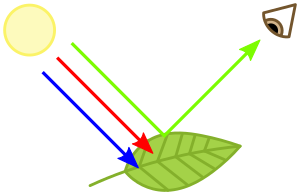
Chlorophylls absorb light most strongly in the <a href="https://en.wikipedia.org/wiki/Diffuse_sky_radiation" title="Diffuse sky radiation">blue portion</a> of the <a href="https://en.wikipedia.org/wiki/Electromagnetic_spectrum" title="Electromagnetic spectrum">electromagnetic spectrum</a> as well as the red portion. Conversely, it is a poor absorber of green and near-green portions of the spectrum, which it reflects, producing the green color of chlorophyll-containing tissues.


myCBSEguide
Trusted by 1 Crore+ Students

Test Generator
Create papers online. It's FREE.

CUET Mock Tests
75,000+ questions to practice only on myCBSEguide app

Shreyshi Karn 5 years, 10 months ago
0Thank You