
Ask questions which are clear, concise and easy to understand.
Ask QuestionPosted by Sushant Chandra 5 years, 5 months ago
- 1 answers
Posted by Sushant Chandra 5 years, 5 months ago
- 1 answers
Meghna Thapar 5 years, 5 months ago
Over 200 years ago, 90 percent of the U.S. population lived on farms and produced their own food to eat. ... Changes in equipment have made a large impact on the way farmers are able to farm and grow food. In the past, farmers would have to do field work by hand or with horse-drawn equipment. Beyond improved seeds and crop protection tools, other technologies enable farmers to increase their productivity, such as modern irrigation practices, crop management products, mobile technology, fertilizer and mechanization management and softwares, like Agrivi, for managing their farms.
Posted by Sushant Chandra 5 years, 5 months ago
- 1 answers
Yogita Ingle 5 years, 5 months ago
The Big Bang Theory is a scientific model that describes how the universe began with a giant blast of matter and energy about 14 billion years ago. As the new universe cooled, tiny particles combined to form the building blocks of atoms, or the basic building blocks of matter.
Posted by Prakash Dhapola 5 years, 5 months ago
- 1 answers
Gaurav Seth 5 years, 5 months ago
Maya's life would be different in South Africa today in terms of equal status in society. She would get a school where children from all classes, rich or poor, high or low, black or white study together. The same hospital would treat her which treats for all sorts of people. She will enjoy equal rights who participate in the affairs of government.
Posted by Hanikha Naidu 5 years, 5 months ago
- 3 answers
Yogita Ingle 5 years, 5 months ago
A Circle has an interior as well as an exterior region as shown in the below figure.
<a href="https://www.math-only-math.com/images/interior-and-exterior-of-a-circle.jpg" rel="gallery[pageGallery]" title="Interior and Exterior of a Circle">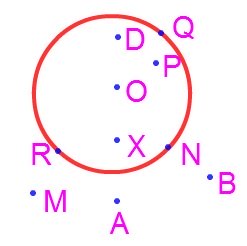 </a>
</a>
Posted by Jagdev Saharan 5 years, 5 months ago
- 4 answers
Yogita Ingle 5 years, 5 months ago
Yes, if we multiply any number with zero the resultant product will be zero.
Example: 2 x 0 = 0, 5 x 0 = 0, 9 x 0 =0
If both numbers are zero, then the result also be zero.
0 x 0 =0
Posted by Siddharth Siddhu 5 years, 5 months ago
- 1 answers
Yogita Ingle 5 years, 5 months ago
It is the most important constituent of food. It is essential for life. The human body contains about 70% of water by weight.
• Water is needed by our body to transport digested food to the body cells and chemicals such as hormones around the body.
• Water is needed by our body to get rid of waste products from the body and to control and regulate the temperature of the body.
• Water also dissolves waste products of the body so that they can be removed through urine and sweat (passing).
• We get most of the water that our body needs by drinking water, milk, tea, coffee and juice.
A diet which contains the right amount of nutrients, roughage and water are called a balanced diet. Roughage, also known as dietary fibres, is obtained from plants such as fruits, whole grains etc. They do not provide nutrients but add bulk to our food and are essential to our body as they aid in digestion.
Posted by Pragya Dey Roy 5 years, 5 months ago
- 2 answers
Gaurav Seth 5 years, 5 months ago
कंट्रोल रूम में जाकर छोटू ने क्या देखा और वहाँ उसने क्या हरकत की?
Answer:
छोटू जब कंट्रोल रूम गया तो उसने देखा सब लोग मंगल पर उतरे हुए यान की वजह से परेशान थे। जब सबका ध्यान स्क्रीन पर था तो उसका ध्यान कॉन्सोल पैनल पर था जिसके बटनों को देखकर वह स्वयं को रोक न सका और बटन दबाने की हरकत कर दी।
Posted by Aditya Prakash 5 years, 5 months ago
- 3 answers
Akash Deep 5 years, 5 months ago
Posted by Pavitra Sharma 5 years, 5 months ago
- 5 answers
Gaurav Seth 5 years, 5 months ago
No, all living beings do not need the same kind of food. Some animals eat plants as food, and they are called herbivores. Some animals feed on other animals, and they are called as Carnivores. Some others eat food from plant sources as well as animals, and such living beings are called omnivores.
Posted by Divyanshu Dhami 5 years, 5 months ago
- 3 answers
Gaurav Seth 5 years, 5 months ago
a “triangle” is a three-sided polygon having three angles. The sum of all interior angles of a triangle will always add up to 180 degrees. This is called the angle sum property of triangle. Also, a triangle has many properties. Let us discuss in detail about the triangle types.
Types of Triangles Based on Sides
According to the lengths of their sides, triangles can be classified into three types which are:
- Scalene
- Isosceles
- Equilatera
Types of Triangles Based on Angles
Triangles can be classified into three types with respect to their interior angles which are:
- Acute-angled
- Obtuse-angled
- Right-angled
Yogita Ingle 5 years, 5 months ago
classification of triangles on the basis of their sides and angles
Equilateral triangle: An equilateral triangle is a triangle whose all three sides are equal.
Isosceles triangle: An isosceles triangle is a triangle whose any two sides are equal.
Scalene triangle: In a scalene triangle, all the three sides are unequal.
Classification of Triangles on the Basis of Their Angles
Acute-angled triangle: If all the three angles of a triangle are acute angles (i.e., each measures less than 90°), it is called an acute-angled triangle.
Right-angled triangle: If one of the angles of a triangle is a right angle (i.e., measures 90°), it is called a right-angled triangle.
Obtuse-angled triangle: If all the three angles of a triangle is an obtuse angles (i.e., measures more than 90°), it is called an obtuse-angled triangle.
Posted by Hanikha Naidu 5 years, 5 months ago
- 5 answers
Posted by Hanikha Naidu 5 years, 5 months ago
- 2 answers
Tiyasha Mandal 5 years, 5 months ago
Yogita Ingle 5 years, 5 months ago
A change is called irreversible if it cannot be changed back again. In an irreversible change, new materials are always formed. Sometimes these new materials are useful to us.
Posted by Richa Sardar 5 years, 5 months ago
- 3 answers
Darshan Patil 5 years, 5 months ago
°_° °_° 5 years, 5 months ago
Gaurav Seth 5 years, 5 months ago
A flowchart is a picture of the separate steps of a process in sequential order. It is a generic tool that can be adapted for a wide variety of purposes, and can be used to describe various processes, such as a manufacturing process, an administrative or service process, or a project plan. It's a common process analysis tool and one of the seven basic quality tools. Elements that may be included in a flowchart are a sequence of actions, materials or services entering or leaving the process (inputs and outputs), decisions that must be made, people who become involved, time involved at each step, and/or process measurements.
COMMONLY USED SYMBOLS IN DETAILED FLOWCHARTS
 One step in the process. The step is written inside the box. Usually, only one arrow goes out of the box.
 Direction of flow from one step or decision to another.
 Decision based on a question. The question is written in the diamond. More than one arrow goes out of the diamond, each one showing the direction the process takes for a given answer to the question. (Often the answers are "yes" and "no.")
 Delay or wait
 Link to another page or another flowchart. The same symbol on the other page indicates that the flow continues there.
 Input or output
 Document
 Alternate symbols for start and end points
Posted by Nikhita Bolake 5 years, 5 months ago
- 1 answers
°_° °_° 5 years, 5 months ago
Posted by Cbyhjdigzhrdjrstw.Dfdu Fdhxgmzhdxufzfs 5 years, 5 months ago
- 1 answers
Gaurav Seth 5 years, 5 months ago
NCERT Solutions for Class 6 Sanskrit रुचिरा भाग 1
</header>NCERT Solutions for Class 6 Sanskrit रुचिरा भाग 1 are the part of NCERT Solutions for Class 6. Here we have given NCERT Solutions for Class 6 Sanskrit Ruchira Bhag 1 as per CBSE guidelines.
NCERT Solutions for Class 6 Sanskrit Ruchira Bhag 1
- <a href="https://www.learncbse.in/ncert-solutions-for-class-6th-sanskrit-chapter-1-akaaraanta-pulligga/" rel="noopener noreferrer" target="_blank">Chapter 1 – अकारान्त – पुल्लिङ्ग:</a>
- <a href="https://www.learncbse.in/ncert-solutions-for-class-6th-sanskrit-chapter-2-aakaaraanta-striilimga/" rel="noopener noreferrer" target="_blank">Chapter 2 – आकारान्त – स्त्रीलिंग</a>
Posted by Archana Mavi 5 years, 5 months ago
- 0 answers
Posted by Jp Srinidhi 5 years, 5 months ago
- 1 answers
Gaurav Seth 5 years, 5 months ago
NCERT Solutions for Class 6 English A House a home
Chapter-01
A House A Poem
Page No: 16
Working with Poem
1. Do you agree with what the poet says? Talk to your partner and complete these sentences.
(i) A house is made of _______
(ii) It has _______
(iii) A home is made by _______
(iv) It has _______
Ans:
(i) A house is made of brick, stone, cement, hard wood, window glass, and a yard.
(ii) It has eaves, chimneys, tile floors, stucco, roof, and lots of doors.
(iii) A home is made by family members.
(iv) It has unselfish acts, sharing, and caring for the loved ones.
For more click on the given link :
<a href="https://mycbseguide.com/blog/ncert-solutions-class-6-english-a-house-a-home/">https://mycbseguide.com/blog/ncert-solutions-class-6-english-a-house-a-home/</a>
Posted by Cm| Black Bolt 5 years, 5 months ago
- 1 answers
Gaurav Seth 5 years, 5 months ago
Inequality is the difference between caste, creed, culture, language, region, economic status, educational background, etc. Everyone differs from the other in society . It occurs if we act on prejudices or stereotypes. It promotes ignorance of a particular class or individual in society. Such class or individual is debarred from all opportunities.
Posted by Vedika Agrawal 5 years, 5 months ago
- 4 answers
Posted by Shwangi Singh 5 years, 5 months ago
- 2 answers
Sanjay Singh Singh 5 years, 5 months ago
Gaurav Seth 5 years, 5 months ago
ARPANET - Advanced Research Projects Agency Network.
The Advanced Research Projects Agency Network (ARPANET) was the first wide-area packet-switching network with distributed control and the first network to implement the TCP/IP protocol suite. Both technologies became the technical foundation of the Internet.
Posted by Shwangi Singh 5 years, 5 months ago
- 1 answers
Yogita Ingle 5 years, 5 months ago
Following are the important features of the town planning of the Harappan cities:
- The Harappan cities were generally divided into two main parts - the raised area; known as the ‘Citadel’, and the lower town. The Citadel was more in height because the buildings in it were built on mud brick platforms. This area was separated from the lower town by a wall. The Citadel had within its fold important buildings like the Great Bath, the assembly hall, the granary and the workshops. The lower town, on the other hand had residential dwellings.
- The main streets of the Harappan cities were built according to the grid pattern. They were built from north to south and from east to west.
- The houses built on the corners of streets were rounded in order to allow the passage of carts. The main road in the city of Mohenjo-daro was 10.5 meters wide and 800 meters long.
- The house drains relayed all the waste water to the drains built in streets.
- The streets were so designed as to cross the main road of the city at right angles, thus dividing the city into square or rectangular blocks.
Posted by Shwangi Singh 5 years, 5 months ago
- 0 answers
Posted by Shwangi Singh 5 years, 5 months ago
- 1 answers
Gaurav Seth 5 years, 5 months ago
A government run by the people is called a democracy. In a democracy, each citizen has a say (or a vote) in how the government is run, thus differentiating it from a monarchy or dictatorship, where one person (the king or dictator) has all the power
Posted by Renee Prasad 5 years, 5 months ago
- 1 answers
Posted by Eliza ?? 5 years, 5 months ago
- 2 answers
Gomathi S 5 years, 5 months ago
Yogita Ingle 5 years, 5 months ago
The rounded structure on the back of the snail is called ashell. It is the outer skeleton (exoskeleton) of the snail. When it starts moving, a thick structure and the head of the snail may come out of an opening in the shell. The thick structure is called foot, which is made up of strong muscles.
Posted by Swayam Bangera 5 years, 5 months ago
- 1 answers
Posted by Vedant Phad 5 years, 5 months ago
- 0 answers
Posted by Renee Prasad 5 years, 5 months ago
- 2 answers
Divyansh Singh 5 years, 5 months ago

myCBSEguide
Trusted by 1 Crore+ Students

Test Generator
Create papers online. It's FREE.

CUET Mock Tests
75,000+ questions to practice only on myCBSEguide app

Krishna Koushik 5 years, 5 months ago
0Thank You