
Ask questions which are clear, concise and easy to understand.
Ask QuestionPosted by Bhuvana Shree 6 years, 7 months ago
- 1 answers
Posted by Firdos Khan. 6 years, 9 months ago
- 2 answers
Vishwa Jani 6 years, 9 months ago
Posted by Firdos Khan. 6 years, 9 months ago
- 1 answers
Posted by Sanghamitra Pattanayak 6 years, 9 months ago
- 1 answers
Meghna Thapar 6 years ago
Human skin color ranges in variety from the darkest brown to the lightest hues.People have different skin colors mainly because their melanocytes produce different amount and kinds of melanin.
Posted by Monis Wani 6 years, 9 months ago
- 1 answers
Pooja Sharma 6 years, 9 months ago
Posted by Jayalakshmi T 6 years, 9 months ago
- 1 answers
Meghna Thapar 5 years, 11 months ago
Biodiversity is the variety and variability of life on Earth. Biodiversity is typically a measure of variation at the genetic, species, and ecosystem level
Posted by Vishwa Jani 6 years, 9 months ago
- 2 answers
Ankur Varshney 6 years, 9 months ago
Posted by Dipal Debbarma 6 years, 9 months ago
- 2 answers
Ankur Varshney 6 years, 9 months ago
Posted by Shruti Shreyansh 6 years, 9 months ago
- 4 answers
Manya Agarwal 6 years, 9 months ago
Pooja Sharma 6 years, 9 months ago
Ankur Varshney 6 years, 9 months ago
Posted by Prince Kumar 6 years, 9 months ago
- 2 answers
Posted by Siari Tripura 6 years, 9 months ago
- 0 answers
Posted by Aga Sumi Sajad 6 years, 9 months ago
- 1 answers
Yogita Ingle 6 years, 9 months ago
Two structures of the inner ear help to maintain balance and equilibrium -
- the three semicircular canals that are interconnected and positioned at right angles to each other just like a gyroscope.
- the vestibule (has the saccule and utricle) that connects the semicircular canals to the cochlea
The semicircular canals and the vestibule of the inner ear together help to maintain the balance and equilibrium of the body.
Posted by Rishika Garg 6 years, 9 months ago
- 3 answers
Pooja Sharma 6 years, 9 months ago
Himanshi Rawat 6 years, 9 months ago
Yogita Ingle 6 years, 9 months ago
Honey bees collect nectar from flowers, convert it into honey and store it in their hive. Flowers and their nectar may be available only for a part of year so, bees store their nectar for their use throughout the year
Posted by Vandana Gambhir 6 years, 9 months ago
- 3 answers
Ankur Varshney 6 years, 9 months ago
Vishwa Jani 6 years, 9 months ago
Yogita Ingle 6 years, 9 months ago
The main components of foods are carbohydrates, protein, fats, vitamins and minerals. These are called nutrients.
Carbohydrates: Carbohydrates are also called energy giving food. It is the main sources of energy. It is made up of carbon, hydrogen, and oxygen.
Protein: Protein helps in body growth and repairs the tissues so it is also called body building food.
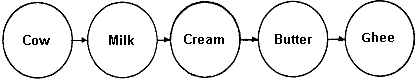
Fat: Fats are made up of carbon, hydrogen and oxygen. Butter, ghee, milk, egg-yolk, nuts and cooking oils are the major sources of fat in our food.
Vitamins: Vitamins are complex organic compounds which are essential for the growth and maintenance of our body.
Minerals: Minerals are required by our body in very small quantities. Iron, Iodine, calcium, phosphorus, sodium and potassium are common minerals. The sources of these animals are plants and animals.
Posted by Diya Thakur 6 years, 9 months ago
- 1 answers
Meghna Thapar 6 years ago
Properties of solids:
- Solids have a fixed shape and a fixed volume.
- Solids cannot be compressed much.
- Solids have high densities. They are heavy.
Properties of liquids:
- Liquids have a fixed volume but they have no fixed shape.
- Like solids, liquids cannot be compressed much.
- Liquids have moderate to high densities. They are usually less dense than solids.
Properties of gases:
- Gases have neither a fixed shape nor a fixed volume.
- They can be compressed easily.
- They have low densities.
Posted by Khushi Gupta 6 years, 9 months ago
- 0 answers
Posted by Pranjal Dhiman 6 years, 9 months ago
- 0 answers
Posted by Bhuvana Shree 6 years, 9 months ago
- 5 answers
Yogita Ingle 6 years, 9 months ago
True, Ingredients of Dal: Pulses, water, salt, oil/ ghee, spices
Posted by Bhuvana Shree 6 years, 9 months ago
- 2 answers
Posted by Bhuvana Shree 6 years, 9 months ago
- 1 answers
Posted by Bhuvana Shree 6 years, 9 months ago
- 1 answers
Posted by Bhuvana Shree 6 years, 9 months ago
- 1 answers
Meghna Thapar 6 years ago
The main carbohydrate that we eat is starch which is mainly present in wheat and rice. Wheat is used in the preparation of chapatti, bread and noodles. Rice is also used in various dishes such as idli and dosa. Good quantity of starch is also present in potatoes. The common sources of carbohydrates in our diet are cereals (maize, wheat, rice), potato, sweet potato, sugar, jaggery, honey and some fruits like mango, papaya, banana and melon. All carbohydrates provide energy to our body.
Posted by Bhuvana Shree 6 years, 9 months ago
- 1 answers
Posted by Bhuvana Shree 6 years, 9 months ago
- 1 answers
Meghna Thapar 6 years ago
Vitamin B1 is essential for growth and proper functioning of digestive system, heart, nerves and muscles.
Posted by Bhuvana Shree 6 years, 9 months ago
- 2 answers
Geeta Singh 6 years, 9 months ago
Posted by Bhuvana Shree 6 years, 9 months ago
- 1 answers
Posted by Bhuvana Shree 6 years, 9 months ago
- 1 answers
Posted by Bhuvana Shree 6 years, 9 months ago
- 1 answers
Posted by Bhuvana Shree 6 years, 9 months ago
- 1 answers

myCBSEguide
Trusted by 1 Crore+ Students

Test Generator
Create papers online. It's FREE.

CUET Mock Tests
75,000+ questions to practice only on myCBSEguide app
