
Ask questions which are clear, concise and easy to understand.
Ask QuestionPosted by Pankaj Kumar 5 years, 7 months ago
- 1 answers
Posted by Nidhi Kundu 5 years, 7 months ago
- 1 answers
Gaurav Seth 5 years, 7 months ago
Question 1.A book exhibition was held for four days in a school. The number of tickets sold at the counter on the first, second, third and final day was respectively 1094, 1812, 2050 and 2751. Find the total number of tickets sold on all the four days.
Answer:
Number of tickets sold on first day = 1,094
Number of tickets sold on second day = 1,812
Number of tickets sold on third day = 2,050
Number of tickets sold on fourth day = + 2,751
Total tickets sold = 7,707
Therefore, 7,707 tickets were sold on all the four days.
Posted by Dhruv Sahni 5 years, 7 months ago
- 5 answers
Dhruv Sahni 5 years, 7 months ago
Dhruv Sahni 5 years, 7 months ago
Dhruv Sahni 5 years, 7 months ago
Posted by Palak Lagah 5 years, 7 months ago
- 5 answers
Posted by Astha Sidame 5 years, 7 months ago
- 0 answers
Posted by Astha Sidame 5 years, 7 months ago
- 3 answers
Suvigya Anand 5 years, 7 months ago
Posted by Astha Sidame 5 years, 7 months ago
- 2 answers
Deeksha Thakur 5 years, 7 months ago
Yogita Ingle 5 years, 7 months ago
A Co-prime number is a set of numbers or integers which have only 1 as their common factor i.e. their highest common factor (HCF) will be 1.
Posted by Puneet Kumar 5 years, 7 months ago
- 0 answers
Posted by Tejas Gunjal 4 years, 11 months ago
- 1 answers
Sia ? 4 years, 11 months ago
Two sides of a quadrilateral are called its opposite sides if they do not have a common end point. Two angles of a quadrilateral having a common arm are called its adjacent angles. In the given figure, (∠A, ∠B), (∠B, ∠C), (∠C, ∠D) and (∠D, ∠A) are four pairs of adjacent angles of quadrilateral ABCD.
Posted by Thirsha Porwal 5 years, 7 months ago
- 1 answers
Posted by Mannat 6A 5 years, 7 months ago
- 2 answers
Posted by Hanikha Naidu 5 years, 7 months ago
- 0 answers
Posted by Hanikha Naidu 5 years, 7 months ago
- 0 answers
Posted by Himanshu Yadav 5 years, 7 months ago
- 3 answers
Gaurav Seth 5 years, 7 months ago
one thousand million
1,000,000,000 (one billion, short scale; one thousand million or milliard, yard, long scale) is the natural number following 999,999,999 and preceding 1,000,000,001. One billion can also be written as b or bn.
Posted by Revansiddappa Birajdar 5 years, 7 months ago
- 2 answers
Posted by Manvitha. H 5 years, 7 months ago
- 1 answers
Sia ? 4 years, 11 months ago
It means that additive identity is “0” as adding 0 to any number, gives the sum as the number itself. For any set of numbers, that is, all integers, rational numbers, complex numbers, the additive identity is 0. It is because when you add 0 to any number; it doesn't change the number and keeps its identity.
Posted by Chandrakant Phalke 5 years, 7 months ago
- 1 answers
Gaurav Seth 5 years, 7 months ago
| 22 | <a href="http://www.leastcommonmultiple.net/lcm-of-2/">2</a> |
| 11 | <a href="http://www.leastcommonmultiple.net/lcm-of-11/">11</a> |
| 1 |
| 24 | <a href="http://www.leastcommonmultiple.net/lcm-of-2/">2</a> |
| 12 | <a href="http://www.leastcommonmultiple.net/lcm-of-2/">2</a> |
| 6 | <a href="http://www.leastcommonmultiple.net/lcm-of-2/">2</a> |
| 3 | <a href="http://www.leastcommonmultiple.net/lcm-of-3/">3</a> |
| 1 |
| 68 | <a href="http://www.leastcommonmultiple.net/lcm-of-2/">2</a> |
| 34 | <a href="http://www.leastcommonmultiple.net/lcm-of-2/">2</a> |
| 17 | <a href="http://www.leastcommonmultiple.net/lcm-of-17/">17</a> |
| 1 |
Prime factors of 22=2 . 11Prime factors of 24=23 . 3Prime factors of 68=22 . 17
LCM = 23. 111. 31. 171 = 4488
Posted by Tanmayee Roy 5 years, 7 months ago
- 0 answers
Posted by Kanishka Sawa 5 years, 7 months ago
- 3 answers
Posted by Vansh Chalana 5 years, 7 months ago
- 1 answers
Posted by Divyanshu Kumar 5 years, 7 months ago
- 4 answers
Posted by Manvitha. H 5 years, 7 months ago
- 5 answers
Posted by Sushant Chandra 5 years, 7 months ago
- 3 answers
Posted by Hanikha Naidu 5 years, 7 months ago
- 3 answers
Yogita Ingle 5 years, 7 months ago
A Circle has an interior as well as an exterior region as shown in the below figure.
<a href="https://www.math-only-math.com/images/interior-and-exterior-of-a-circle.jpg" rel="gallery[pageGallery]" title="Interior and Exterior of a Circle">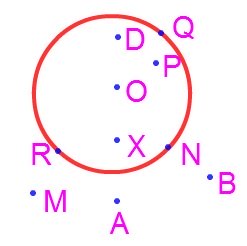 </a>
</a>
Posted by Jagdev Saharan 5 years, 7 months ago
- 4 answers
Yogita Ingle 5 years, 7 months ago
Yes, if we multiply any number with zero the resultant product will be zero.
Example: 2 x 0 = 0, 5 x 0 = 0, 9 x 0 =0
If both numbers are zero, then the result also be zero.
0 x 0 =0
Posted by Divyanshu Dhami 5 years, 7 months ago
- 3 answers
Gaurav Seth 5 years, 7 months ago
a “triangle” is a three-sided polygon having three angles. The sum of all interior angles of a triangle will always add up to 180 degrees. This is called the angle sum property of triangle. Also, a triangle has many properties. Let us discuss in detail about the triangle types.
Types of Triangles Based on Sides
According to the lengths of their sides, triangles can be classified into three types which are:
- Scalene
- Isosceles
- Equilatera
Types of Triangles Based on Angles
Triangles can be classified into three types with respect to their interior angles which are:
- Acute-angled
- Obtuse-angled
- Right-angled
Yogita Ingle 5 years, 7 months ago
classification of triangles on the basis of their sides and angles
Equilateral triangle: An equilateral triangle is a triangle whose all three sides are equal.
Isosceles triangle: An isosceles triangle is a triangle whose any two sides are equal.
Scalene triangle: In a scalene triangle, all the three sides are unequal.
Classification of Triangles on the Basis of Their Angles
Acute-angled triangle: If all the three angles of a triangle are acute angles (i.e., each measures less than 90°), it is called an acute-angled triangle.
Right-angled triangle: If one of the angles of a triangle is a right angle (i.e., measures 90°), it is called a right-angled triangle.
Obtuse-angled triangle: If all the three angles of a triangle is an obtuse angles (i.e., measures more than 90°), it is called an obtuse-angled triangle.
Posted by Hanikha Naidu 5 years, 7 months ago
- 5 answers
Posted by Vedika Agrawal 5 years, 7 months ago
- 4 answers
Posted by Renee Prasad 5 years, 7 months ago
- 1 answers
Posted by Vedant Phad 5 years, 7 months ago
- 0 answers

myCBSEguide
Trusted by 1 Crore+ Students

Test Generator
Create papers online. It's FREE.

CUET Mock Tests
75,000+ questions to practice only on myCBSEguide app

Priyanshu Kumar 5 years, 7 months ago
1Thank You